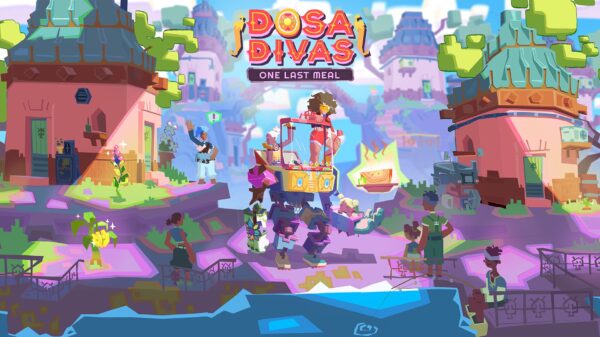













































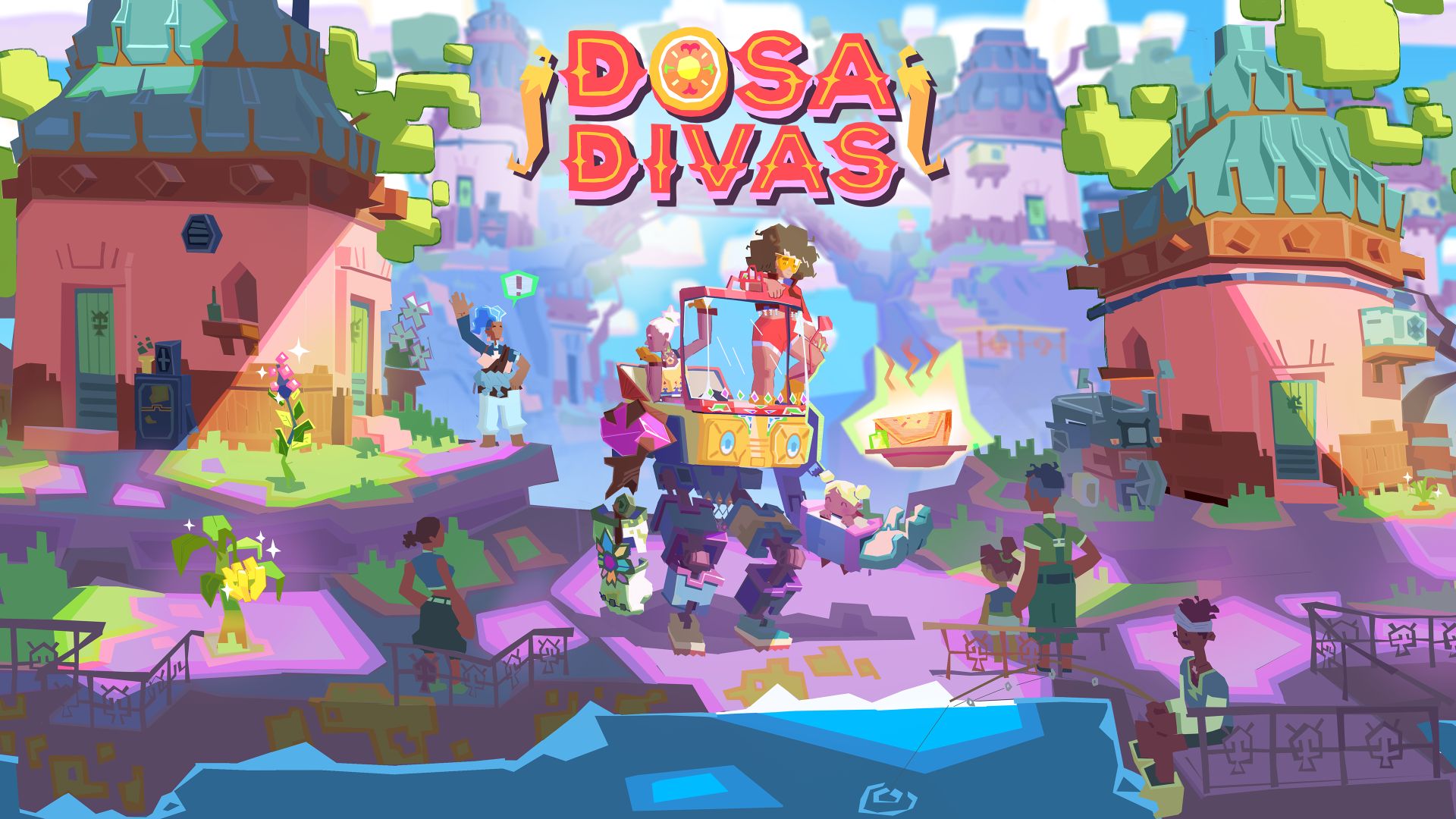

Dosa Divas packs a turn-based RPG into a small package, but the shorter run-time hinders as much as it helps. A lack of depth in the combat makes the 12-hour runtime drag, and a stiffness throughout gameplay lessens the experience. The story has emotional depth and vibrant characters, but holding key details until the end makes for a rushed ending that doesn’t quite stick the landing.
Samara and Amani, sisters who haven’t seen each other for ten years, reunite for a road trip to see their parents in their spirit-mech Goddess. The two used to run a restaurant together before Amani disappeared after a tragic incident, one that won’t be made clear until much later. This setup sends our two sisters through the neighboring towns they used to live near, where they see old friends.
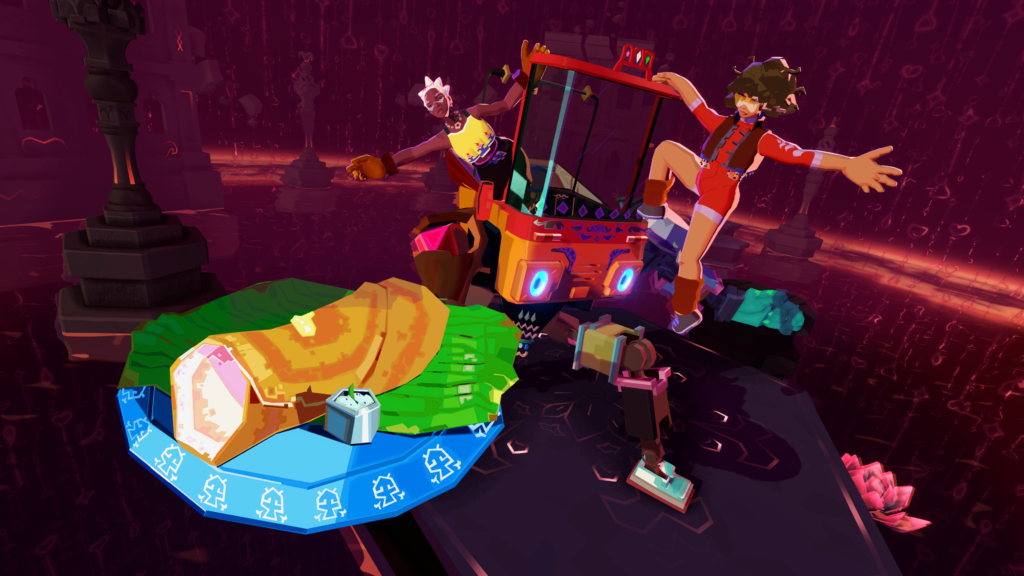
Unfortunately, the world has stopped caring about cooking, instead opting to eat food out of a tube, made by a massive evil corporation run by their other sister, Lina. Lina’s evil corporation has brought the boot down on these small towns, squeezing them for profits while forcing them to consume her food tubes.
This premise sets up a clearly incoming family conflict, but the details of what happened aren’t revealed until much later. By the time it’s made clear, you’ve already gotten a pretty good idea, but this incident shapes not only the sisters but also the other major characters you run into in each small town. It makes it difficult to get invested in the character dynamics when you’re missing information they have. For example, Yomi, the first character from Amani and Samara’s past you encounter, hates Amani.
She hates Amani for bailing after the incident, and the dialogue sells this incredibly well, but without context, it’s hard to understand. Plus, Yomi has started working for Lina, oppressing her own people, making it difficult to empathize with her pain without having a clear picture.
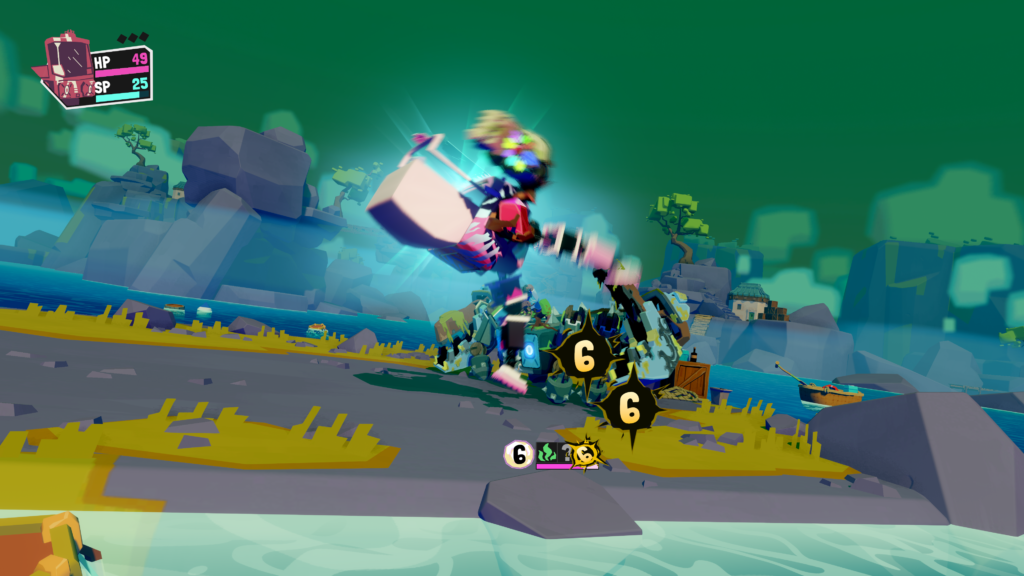
In each area, you will encounter a variety of Lina’s goons and different kinds of corporate enforcers, such as tech bros and cops. There’s a small selection of different enemy types, which have different attacks for you to deal with. Dosa Divas is turn-based, but incorporates active-battle elements, requiring a timed-button press for blocking incoming attacks and dealing extra damage on your attacks.
The timing for blocking attacks feels just slightly off, even with the audio and visual cues, including a symbol that appears. Even with the accessibility options, I never felt like I had the timing down, even if I was consistently blocking incoming attacks. It’s hard to tell if the window is odd or if there’s some delay between pressing the button and blocking, but even when it worked, it never felt satisfying to do.
With the shorter runtime, there isn’t much depth to the abilities you can gain. Even by the end of the game, I only had two or three skills for each of the three party members, making nearly every fight in the game feel identical. Enemies have weaknesses to certain attack types and become Stuffed when you break their stance, opening them up to big damage. Because your options are so limited, it was more often than not faster to just brute force with my most powerful skills, since SP regenerates after every battle, taking any strategy out of the combat.
Boss fights require a bit more finesse, and a second round of boss battles in the latter half of the game introduces special win conditions that make them far more dynamic, but every fight against regular enemies felt identical throughout the experience. New combat abilities are locked behind town reputation, which is improved through various activities like taking down propaganda or cooking for locals, but certain levels are story gated. Only gaining new skills at certain story beats is a little frustrating, especially when there are so few skills to begin with.
The cooking mechanic is a series of minigames, which change depending on the recipe you are making. While there is an option to free-style, every quest and request you get to cook is for a set recipe. You auto fill in the ingredients, assuming you collected them while exploring each town, before doing the minigames.
Some of the minigames work well, like the prayer minigame, where you have to keep a dot inside a circle using the thumbstick as it fights against you. That one is just frantic enough that you have to be reactive, making for an exciting challenge. Others, like rotating the thumbstick at the correct speed, never seemed to work well, as the required precision didn’t match how precisely a thumbstick can be rotated.
The cooking minigames are quick, and I never fully failed to cook a recipe, but its biggest contribution to the experience is the emphasis on cooking as a communal experience. Samara, Amani, and Goddess work together to create flavorful dishes for people in a way that’s far more personalized and thoughtful than tubes of food paste. It’s the one aspect of the gameplay that elevates the themes of Dosa Divas in a way that resonated with me, and the minigames that were enjoyable never outstayed their welcome for me.
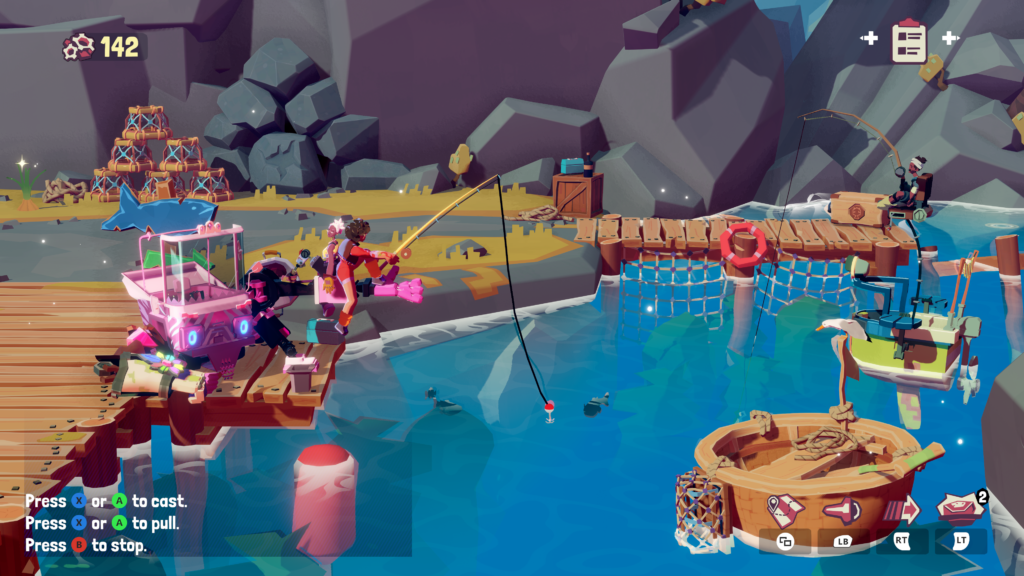
Exploring the world is mostly a tedious task, having you loop through small sections of the area, often connected by some type of small bridge or other traversal. You’ll need to loop these areas multiple times, both for story quests and to collect ingredients. There are side activities, like destroying propaganda, but the movement itself feels stiff and strange. When I had to jump or perform more complex platforming maneuvers, the game would often lose the direction I was moving with the stick, causing Goddess to run in the wrong direction when I landed. Between the janky movement and the endless loops through each area, exploration was more of a chore than anything else.
Average
The Final Word
While I appreciate the smaller scale of Dosa Divas, the experience feels unpolished and unrefined. The combat is shallow, even for a 12-hour experience, and the story holds too many cards for the climax, so the moments leading up to it don’t really resonate. The cooking mini-game is a highlight, and the themes about how important cooking is to both culture and community do hit, but the specific story ultimately feels flat.