





















































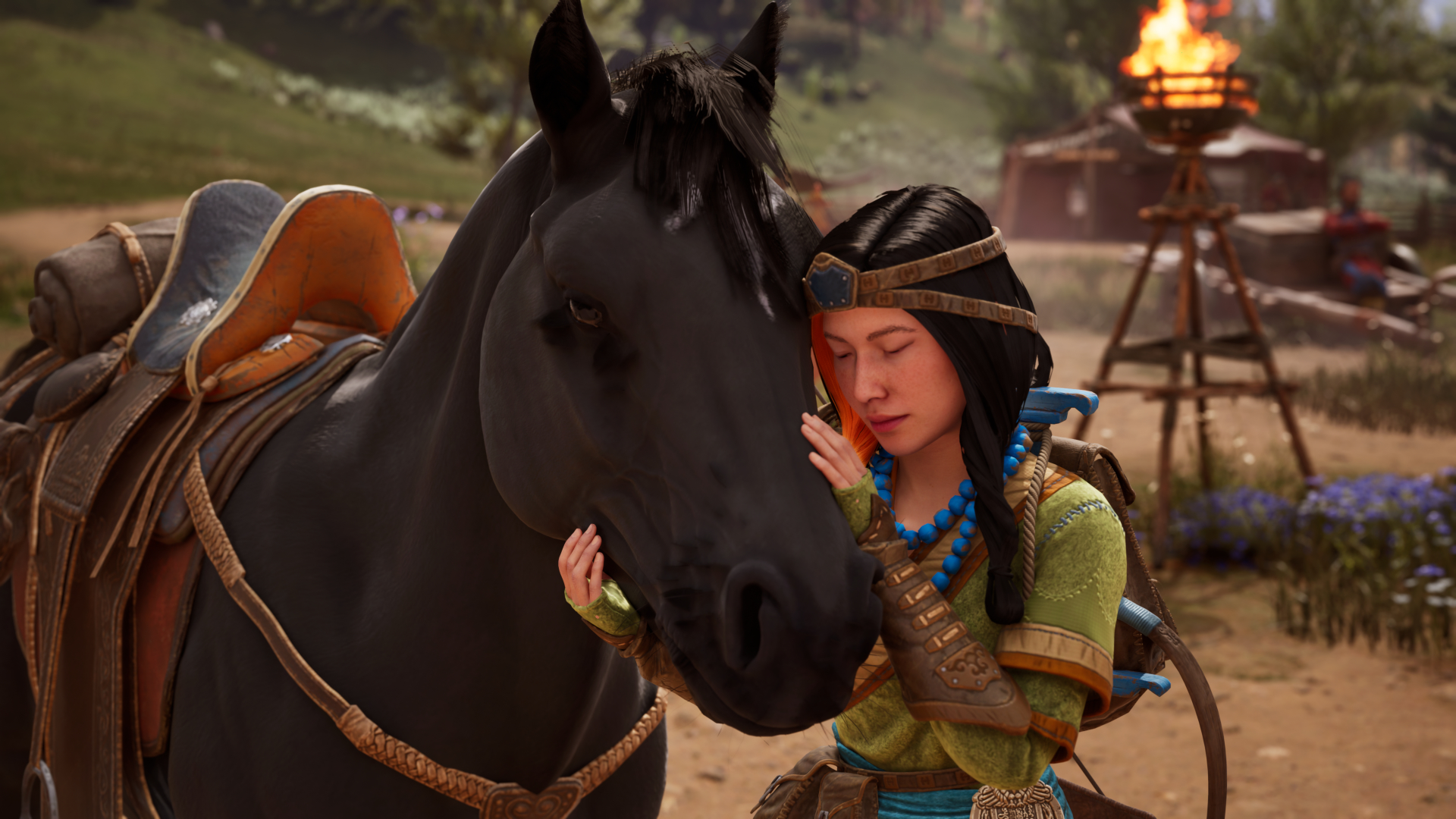

Naraa has a job to do: she’s a Yam courier who travels Mongolia on horseback, trusted to deliver valuable cargo across oft-treacherous landscapes. Key to her success is her partnership with her horses — the animals’ strength and speed can make or break her journeys.
In The Legend of Khiimori, Aesir Interactive seeks to immerse the player in an experience that feels authentic both to the practice of caring for horses and the game’s setting, which is rooted in real history. Naraa’s role as a Yam courier is based on 13th-century Mongolian messengers who traversed a route of the same name. Starring alongside her is a cast of horses that could plausibly have been found in Mongolia at that time, which she can tame, bond with, train, and breed.
In conjunction with the game’s early access release, Senior Character Artist Valentin Pavliuchenko and Consultant for Marketing and Horse Accuracy Alice Ruppert spoke with MonsterVine, providing insight into the studio’s approach to equine authenticity.
Stable Chores and Equestrian Inspiration
With The Legend of Khiimori’s horse-centric gameplay, Aesir Interactive aims to strike a balance between realism and fun. Per Ruppert, “We want enjoyable mechanics, but we don’t want those to be separate from the horse.”
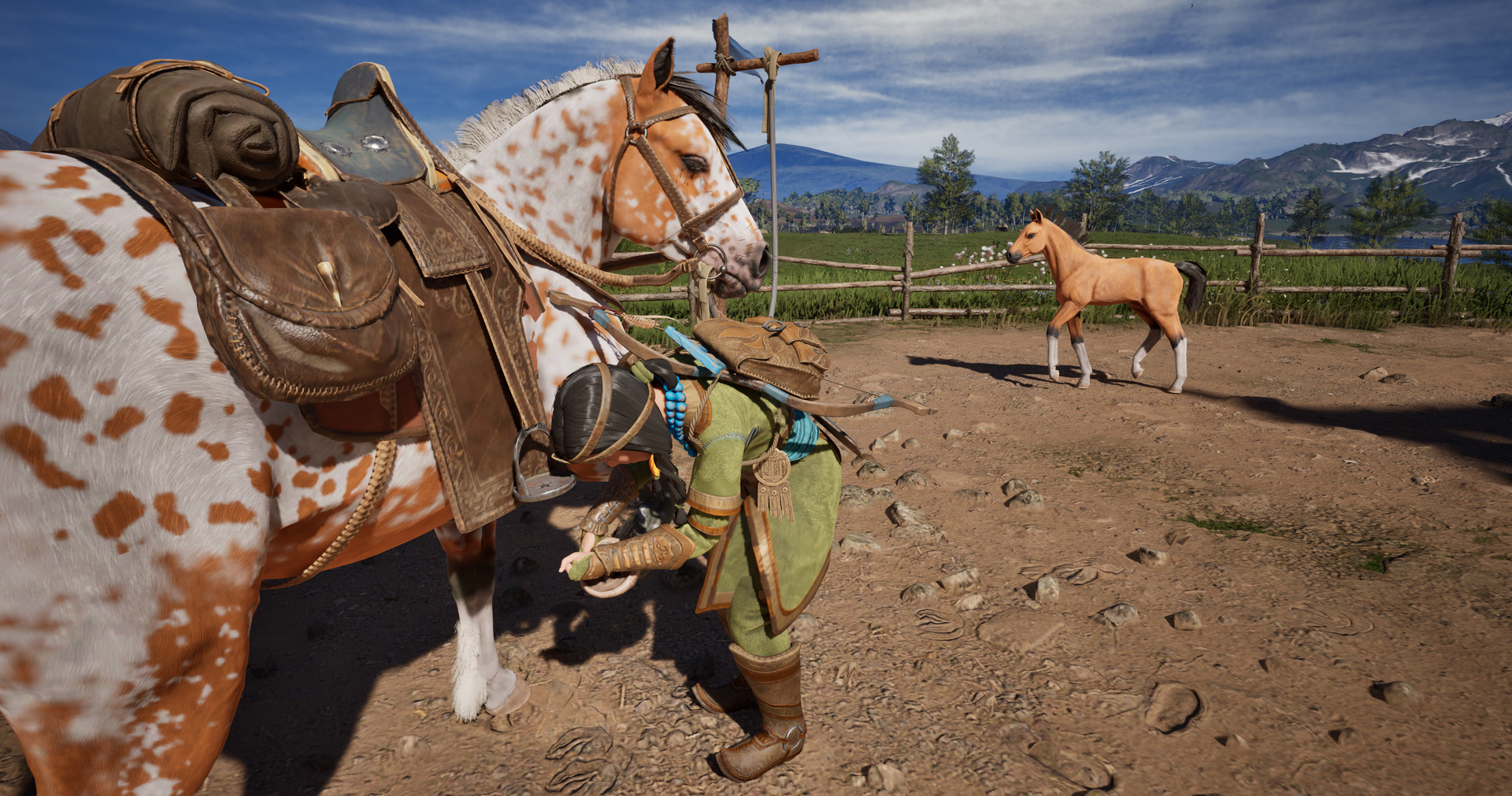
That said, the reality of horse care involves a lot of repetitive tasks, from chores like brushing and hoof maintenance to bigger jobs like mucking out stables and treating medical issues. Unlike a lengthy cutscene, these responsibilities are not skippable.
According to Ruppert, when designing a horse game, a key question is, “How many stable chores are an important part of realism and how much is just annoying tedium?” Recurring care mechanics can become boring to the player, especially if they must be repeated ad nauseam with no ability to lessen their burden. However, if these mechanics are removed, the absence is felt — a horse that requires no feeding or brushing seems unreal.
“I do think it’s very possible to make these care mechanics in a way that is both satisfying and that satisfies that realism need without falling into tedium,” she says. She points out that Legend of Khiimori’s setting helps to alleviate one issue, as there is no stable in the game and therefore no need to worry about mucking it out. “The game doesn’t actually simulate horse ownership in the modern sense, as we know it, like many other games do. So if you have all of the steppe ahead of you, you’re not going to shovel poop, at least not while you’re on the road.”
Still, she notes, players can expect to fulfill a range of needs for the horses in their care in order for them to “stay fit on the road.”
Although integrating realistic horse care into the game in a fun way is one of the main challenges the developers faced, in some cases, real-world equestrian practices helped provide gameplay solutions. For the game’s resource gathering mechanic, the studio took inspiration from the sport Tenge Ilu, in which riders hang from their saddles to snatch objects from the ground at high speed. By using it as the basis for the game mechanic, designers were able to create a believable way for Naraa to forage from horseback.
“The cool thing about the Tenge Ilu … is that, of course, it interacts really, really nicely with mechanics that we already had,” Ruppert says. “It’s not really an addition. It’s just a way to make collecting from horseback both more fun and more authentic.”
Historic Horses
The balance between authenticity and playability is also exercised in the selection of horse breeds that are currently represented in the game — the Mongolian, Ferghana, Akhal-Teke, and Limousin — which were chosen both for their variety of characteristics and for their plausibility as relates to the setting. Each of the aforementioned horses existed in the 13th century and could ostensibly have been found in Mongolia, although the Limousin was more far-flung, since it originated in Western Europe.
The primary horse in the game is the Mongolian, a sturdy breed that stands in contrast to the “tall and long-legged” appearance of modern warmblood horses, which adhere to what Pavliuchenko jokingly describes as “unrealistic horse beauty standards.” For their part, Mongolian horses are known for their endurance and are still present in the region today.
With the addition of the Ferghana, Akhal-Teke, and Limousin, the developers sought to add variety “without compromising too much on [the] believability and the authenticity of the setting,” Ruppert explains. A key player who assisted with research into horse breeds for the game is Artemisia Clare, a horse historian and Curator of Exhibits at the International Museum of the Horse. “The Limousin was definitely her find,” says Pavliuchenko.
Although the Limousin is from Western Europe, its availability is handled in a believable way. “For the Limousin, yes, there’s no direct evidence [of its presence in Mongolia], but the Silk Road was well established by that time and it did connect those regions to each other and the trade did flow both ways,” Pavliuchenko notes. The key word is trade: in the early access release, only Mongolian horses can be caught in the wild, while the other three breeds in the game can be obtained from a trader.
An Act of Revival
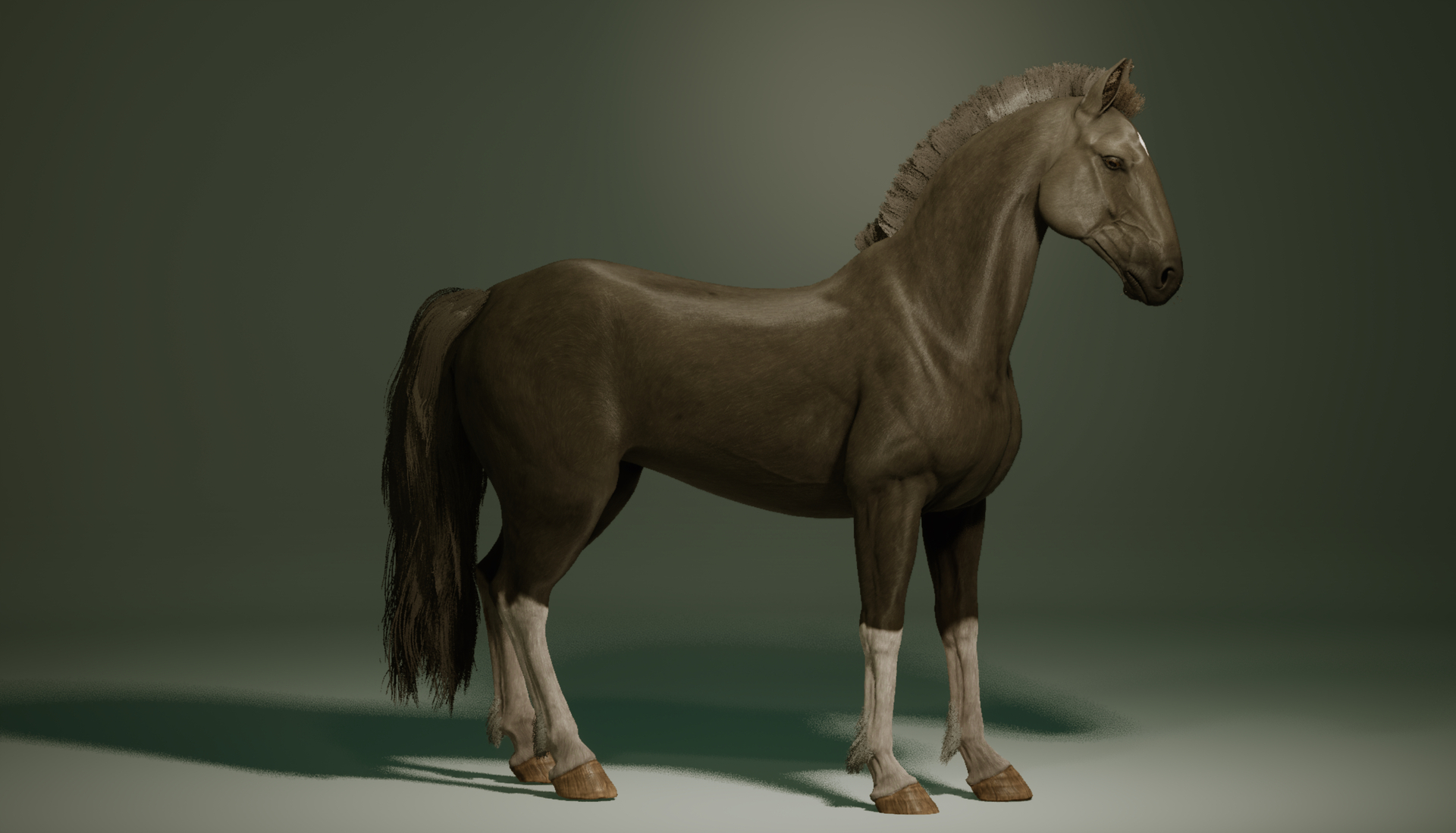
Two of the four breeds included in Legend of Khiimori are now extinct, which added an element of difficulty to gathering reference material for the game. Like the Mongolian, the Akhal-Teke still exists today, but the Limousin and Ferghana are long gone. The Limousin remained in existence long enough that there are photographs of the horse available to use as reference, but no such evidence exists for the Ferghana.
According to Ruppert, “the Ferghana went extinct roughly around the time where our game is set, or sometime thereafter. So it’s realistic that it still exists [in Legend of Khiimori], but many of the artifacts that depict the Ferghana are even older.”
Designers drew clues about the breed’s traits from sculptures, reliefs, and paintings of the Ferghana, particularly relating to characteristics that were often exaggerated in artworks depicting the horse. “For example, they have a super cresty neck, so they have a very round, arched neck,” Ruppert says. “They have a very heavy body on relatively slender legs, not quite like a modern draft horse that’s just heavy all around, but also not like a lighter breed like an Arabian.”
Pavliuchenko explains that further inspiration was available both from living horses purported to be descended from the Ferghana and from historical texts, allowing for cross-referencing between sources. “There were some textual descriptions from historical documents that were, to a degree, more helpful than visual representations, I would say, because visual representations … could be very, very stylized,” he says.
In a way, this process of interpretation is something of an act of revival.
“I guess [the Ferghana was] the hardest one to do,” Pavliuchenko says. “On the other hand, it was also the most interesting one to do. It was an interesting challenge to try and bring back this extinct horse, kind of, to life.”