


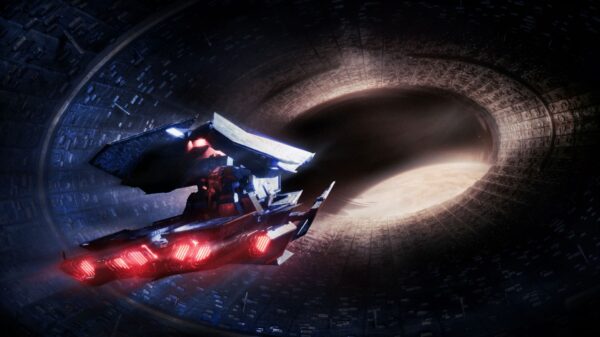


Warhammer 40,000: Mechanicus II is a turn-based tactical RPG that tries to be a number of things, and manages to succeed at a few of them. While I was able to derive some early 2000s real-time strategy game nostalgia from Mechanicus II, much like the Necrons slumbering under Qivroth, Mechanicus II has to wrestle with the fact that times have changed. While the core Warhammer audience is sure to be pleased with the endless betrayals, deliciously rendered art and graphics, the space-fascist equivalent of rap battles, customizable gameplay, and even a reduced price tag may not sway those who don’t follow the Omnissiah to pick up Mechanicus II.
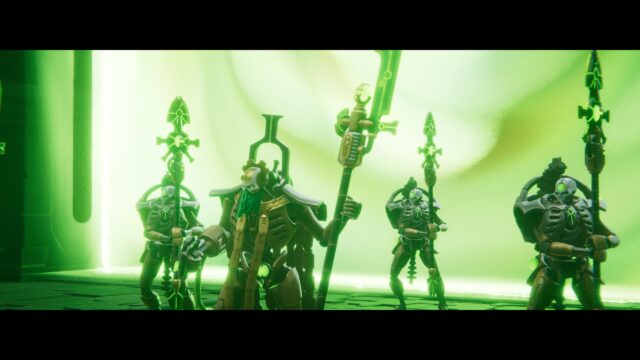
Warhammer 40,000: Mechanicus II starts up where the original Mechanicus left off. The Adeptus Mechanicus, in their divine wisdom, decided that the Xeno-infested planet Silva Tenebris was too much of a threat and decided upon the ultimate fate, an Exterminatus. Understanding the Omnissiah is a never-ending task, so some time later, many of the same Tech-Priests under the command of Magos Dominus Faustinius arrive on Hekateus IV only to find one of the greatest forms of heresy. The forces of the Emperor soon learn that the very planet they stand on was once named Qivroth, and is a Necron Tomb World. While all Xenos are blasphemers, the Necron, their living metal, and thinking machines are anathema to what the Adeptus Mechanicus stands for.
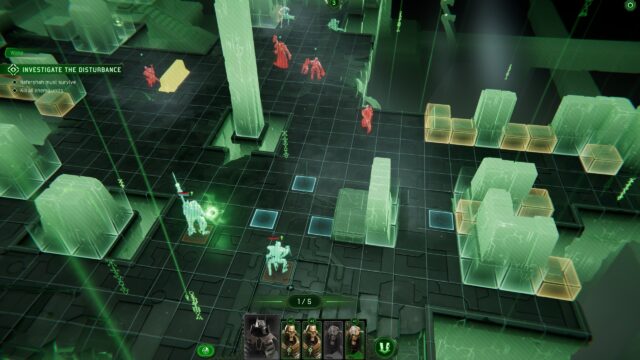
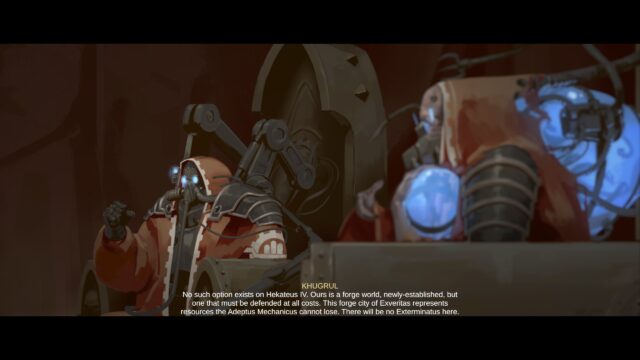
The Necrons, awoken by these baseless invaders, aren’t simply going to hand the planet to Cult of the Machine. The mighty Phaeron Sankhotep is awakened, though The Great Sleep had dulled Necron technologies and defenses. Compounded by some shockingly brazen disloyalty, leaving Vargard Nefershah to clean up quite the mess. Unlike the first Mechanicus, players will also be able to play as the Necrons, culminating in an epilogue. While Warhammer 40,000: Mechanicus II pits the Machine Cult against Necron, players will encounter some surprises in the form of Gods, Space Marines, and the Kin. Whether they’re friend or foe is less relevant than who has the last laugh. While the smaller pieces of the story lead to gameplay that amounts to “kill everything you don’t like,” the broader strokes, a strong base of lore to draw from, and character dynamics powered by excellent voice acting and script kept me engaged. I don’t know much about Warhammer 40,000, but I felt like I should have popcorn in hand and a Twitter hashtag to follow the drama. It is also worth saying that despite not playing the original Mechanicus, I was engaged all the same due to returning scribe Ben Counter’s efforts. Counter even manages to make the “what if”/dual-narrative weave together nearly seamlessly.
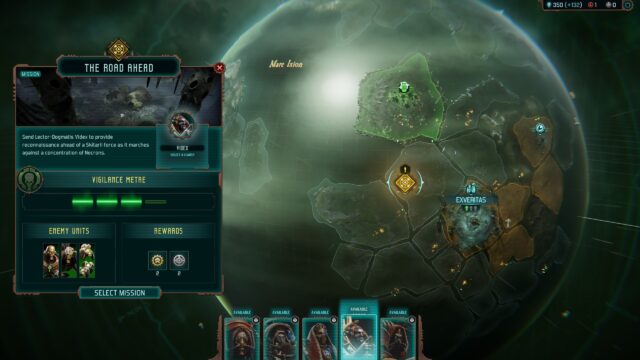
The gameplay of Warhammer 40,000: Mechanicus II is fascinating. Nearly every mission involves the player moving through territory where they will have to make choices that can affect upcoming battles. Players will have to be wary of the Vigilance meter, as some of the choices they make will be risky, and ultimately, a full Vigilance meter will spawn additional enemies in the next encounter. Players only have a limited retinue to bring with them on missions, and as Adeptus Mechanicus, a requisition cost. Many leaders have differing playstyles, but after being used on a mission, they must rest or could be assigned elsewhere, so it isn’t wise to just stick with Tech-Acquisitor Scaevola, for instance. A nice feature is that between missions, you’re able to reallocate resources in case your next mission calls for a more mobile or debuff-resistant force. Building up your units, leaders, and resources is paramount to surviving Mechanicus II.
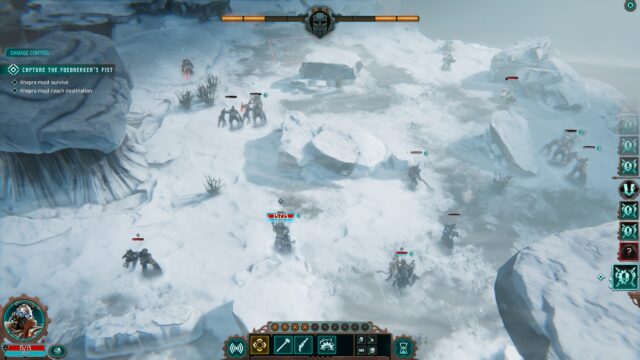
While tactical RPG players may be familiar with the basics of cover, hero units, and skills, there are some more intricate design decisions that engaged me in the same way some of the real-time-strategy games I remember fondly from childhood. The biggest of which is melee combat. While you may wonder how a melee unit could possibly outrank someone with a gun, being in melee range of an enemy character allows for an attack of opportunity. Attacks of opportunity are done automatically when a unit tries to move out of melee, and with ranged units, this usually shuts off their attack. The ability to inconvenience an enemy unit, possibly keep them from attacking, and even kill them without using resources was almost more valuable than bombardment or gunfire in my playthroughs. This also activates for each unit, so sending a number of low-level units like Servitors or Flayed Ones to gang up on a bigger ranged unit is beyond satisfying.
There are also some aspects of Mechanicus II that are from an earlier era, for better or worse. Most notably, even though the game auto-saves, players should still make manual saves so they’re not put in an unwinnable situation. Even with the game skirmish speed set to 300%, it doesn’t actually move at a flat 300%, and the game is determined to have you sit through certain animations. While Mechanicus II is not a short game, sitting through the seventh Fanatical Devotion activation or the game’s unresponsive ‘end turn’ system made it feel like more of a chore, and these problems have been solved by peers in the industry for years. This is in addition to significant load times. The Necron faction also seems to be quite a bit weaker than Adeptus Mechanicus, with one of their main gimmicks of units reviving themselves being impractical to the point of frustration. I definitely recommend players take advantage of the ability to customize difficulty with the game’s numerous sliders before committing to a harder difficulty like Grim Darkness.
Average
The Final Word
Warhammer 40,000: Mechanicus II is a game with pretty obvious flaws that won’t deter fans of the franchise already, but the glacial pace, lack of variety, and limited selection of music may make this hard to swallow for others. There is a “rustic” charm to it as someone who grew up on PC games like this, and it does provide an interesting Warhammer experience even as someone who’s only glanced at the wider property. If you do want to take up arms, the presentation, art, visuals, and well-realized cast, combined with a fairly modular experience, could provide dozens of hours of fun.