













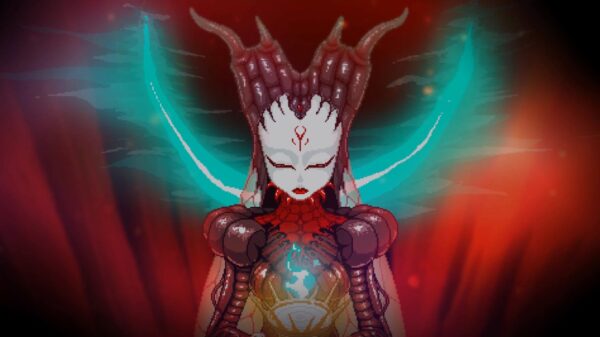







Forced to participate in a mysterious auction for items linked to “Dictator X” to learn the truth about your father’s death, you must investigate the secrets of each participant to piece together memories of the past, in the latest mystery game written by Rika Suzuki, the writer of Another Code and Hotel Dusk.
Dark Auction
Developer: IzanagiGames
Price: $35
Platforms: PlayStation 5, Nintendo Switch (reviewed), PC
MonsterVine was supplied with a Switch code for review.
Set in 1981 Germany, Dark Auction begins with a young man named Noah traveling to a mysterious castle. His father had gone there to attend a special auction due to his obsession with collecting items related to Dictator X, but he never returned. When Noah arrives, he learns that his father is dead due to not providing accurate memories, which is the price of bidding on items at this auction. Not only that, but no one can leave until the auction is finished. With no other way to get answers, Noah enters into an uneasy alliance with the Auctioneer. He agrees to investigate the other participants and ensure the remaining auctions are successful, in exchange for being told the truth about his father afterward.

You might remember this game was originally announced as Dark Auction: Hitler’s Estate, featuring an auction of items related to Hitler, before it was rebranded as being about “Dictator X.” However, the historical context is still intact, so the change comes across as pointless and almost nonsensical censorship. Conversations and flashbacks throughout the game deal with a dictator who is unambiguously Adolf Hitler, except the game says his name is X. It doesn’t appear to be a localization choice, either, since you can hear the Japanese voice actors saying “X” in the dialogue. I don’t know what is gained by this. Anyone uncomfortable with playing a game about an auction for Hitler memorabilia will be just as uncomfortable with the game’s premise as it stands, and since many parts of the story involve characters learning their relatives were close associates of “Dictator X,” this context can’t be avoided or ignored.
Anyway, the key behind this strange auction is that instead of bidding with money, the participants must offer up their memories. Each evening, one participant will be chosen to bid on a specific item using a machine that reads their memories and turns them into film. Any inaccuracies in those memories can cause their death, so they are allowed to have a “supporter” to help ensure there are no mistakes or lies. As part of his deal with the Auctioneer, Noah is told each day’s bidder in advance and tasked with investigating them and ensuring they choose him as their supporter. Therefore, the game is split into two types of gameplay: investigations and auctions.

The castle is a 3D environment that you explore in first person, though most rooms lock you in place and force you to investigate from a fixed perspective, in a point-and-click style. Dialogue is handled through the use of sprites like a visual novel, and the longer I played, the more I wished it was a visual novel instead. The game is extremely linear, with nothing to find off the beaten path and very little optional dialogue. Investigating requires you to click items in the environment and ask characters questions, but there’s only minor variation in the order. Each character is lying about something that you need to figure out, which could have led to a neat bit of deduction, but Noah figures it out on his own without much fanfare. Even collecting coins to use in the castle’s puzzle box is scripted. Dark Auction feels like a visual novel that forces you to walk from one scene to the next, and since the 2D art is superior to the 3D character models anyway, I can’t help but think it would have felt better as a visual novel.
As such, the only real gameplay comes in during the auctions. You’ll be presented with several incomplete memories, which you need to finish by choosing the missing items from each scene. After that, you need to place them into a chronological timeline. The third step is to point out lies or mistakes in the memories, based on the information you gathered during the day. Sometimes these lies are obvious if you’ve been paying attention, while other times they’re a bit trickier. Finally, the fourth step involves restoring incomplete memories with new elements gained during the previous section. If you make a mistake, the bidder’s health decreases, so you need to be careful. This is a nice bit of gameplay that works well both for this style of mystery game and as an examination of how people’s own memories can mislead them.

Dark Auction Is a Thoughtful Mystery That Feels Held Back
Each chapter focuses on a different character, while clues about the larger mystery surrounding the auction and Noah’s father slowly come together. A quiz at the end of each chapter helps you keep the relevant details in mind. Surprisingly, “Dictator X” doesn’t have a lot to do with the overarching mystery, but is mainly part of the characters’ individual arcs as they learn about their family’s actions in the final days of his regime. The characters are all fairly likable, especially as you learn more about them and they grapple with the revelations from the auctions. However, some aspects of their character arcs fail to reach their full potential, and that’s a criticism that extends to the entire game. What’s here is good, but it feels like it could have been so much more. That’s especially true of the finale, where the story takes some surprising and dramatic turns but leaves behind lingering questions and loose ends. It’s decently satisfying, but it could have used more time to truly flesh things out.

Dark Auction has some typos and mistakes in its text, but there’s nothing too jarring. Additionally, some parts feel a little tedious, such as the Auctioneer telling you on every single page of a memory that you need to fix it. Saying it at the start and end of each memory sequence would have sufficed. On a more frustrating note, players called out the game for undisclosed generative AI use after its launch, and the developer admitted to using AI as “inspiration” for elements such as the in-game painting up for auction in the first chapter. They’re now in the process of patching those out and replacing them with new art drawn by the main artist, but it’s a shame it took fan backlash for that to happen. It’s also a shame that Dark Auction has shadows like this cast over it, because when you look at the character interactions and storytelling, it really does have potential.
 The Final Word
Dark Auction left me asking “why” quite a bit. Why are we calling the leader of Germany during World War II “X”? Why was AI generated art used at all, especially in a part of the story that talks about the importance of art? Why isn’t this a visual novel, when the 3D exploration adds more tedium than value? Why does the ending feel like it needs a lot more context? Nevertheless, there are still a lot of good moments here, especially in the final chapters when the mystery starts to come together. It’s an interesting story with some unexpected developments, but it just feels like it could have been much more than it is.
MonsterVine Rating: 3 out of 5 – Average