
![Kingdom Hearts Collection [I~III]](https://monstervine.com/wp-content/uploads/2026/10/KHC-Review-Art-600x337.png)









































































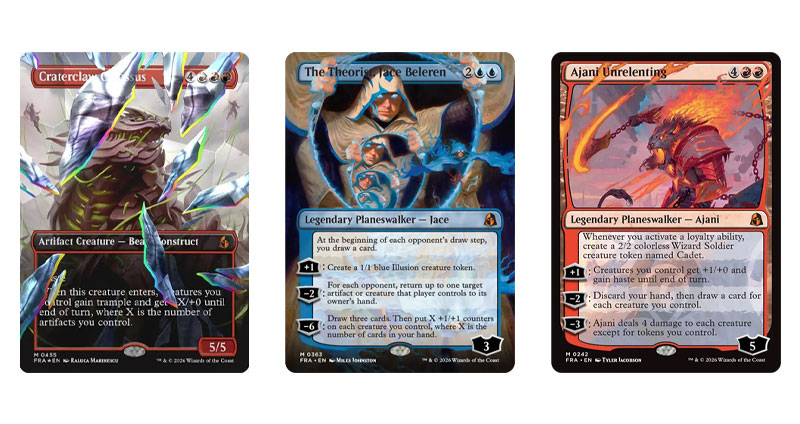
For years now, Jace has been popping in and out of sets, poking around in the background, cooking up some sort of plot. Now his machinations have come to fruition, and it’s revealed that he’s been working to create his own “perfect” universe; the only downside is that for his perfect world to exist, the old needs to die. This is the setup for Reality Fracture, probably one of the most exciting sets in Magic the Gathering history, as it culminates years of storytelling into one big finale.
DJ Jace With the Remix
Reality Fracture is all about seeing the effects of Jace’s new Echoverse and how it mirrors Magic’s original reality. To show this, you’ll see countless cards featuring Jace’s symbol, watermarked in the text box, to indicate a card comes from the Echoverse. There’s no better way to see Jace tinker with reality than in the cards for the five original planeswalkers, the Lorwyn Five, who all return in this set. Liliana, famously a mono-black creature, is remade by Jace in white as Liliana the Faultless. In Reality Fracture, our original Liliana has an ability that anytime a creature you control enters, you mill two cards; Jace’s Echoverse version makes you gain life instead.
Other characters from Magic return as well, and you can see Echoverse pairs of them. Tinybones, for example, is remade as Titanbones Towering Heart, swapping his black color identity for green and becoming a hulking behemoth. It’s really exciting seeing what cards from Magic history get twisted in new ways thanks to Jace’s tinkering with the multiverse, and discovering new takes on classic cards has been half the fun of pulling cards from the set.
Two new mechanics hit the set: Empower Jace and Heartwood tokens. The latter is pretty simple: some cards (like Tenured Tethermage) can create a Heartwood token, a red/green artifact that can tap for red or green mana. It’s a nifty ability that helps green ramp even faster than it already would, while giving red an option to ramp. Empower Jace is a really cool new mechanic, as it’s the first time you can make planeswalker tokens. Cards like Sanctum Lurker will allow you to Empower Jace; this card in particular states that when it enters, you can Empower Jace 1. This means two things: if you already have a Jace planeswalker token, then you can add 1 loyalty counter to it, but if you don’t have a Jace token, then you’ll be able to create one and add the 1 loyalty to it. If you create a Jace token, it’ll have the following planeswalker abilities: -1 Surveil 1 and -3 Draw a card.
Being able to create a planeswalker token that allows you to check the top of your deck and draw from it is a super exciting new thing to do in Magic. As you can expect, there are a lot of cards in this set that can Empower Jace, and it’s not a legendary card, so you could theoretically create multiple Jace tokens and start empowering them all. Imagine creating a token copy of Jace Reality Sculptor, then using Overwrite the Multiverse to wipe the board and add a ton of loyalty counters to that token to then activate its 0 ability and decking every other player, effectively winning the game? There’s a lot of really fun ideas you could do with a deck filled with Jace cards, cards that can create token copies of those Jaces, and then cards to empower those token Jaces.
Drafting the set was a complete blast too. One night I played, I ended up with two decks: a green/white focused on life-gain and a blue/black filled with Empower Jace cards that I used to draw my heavier hitters. The latter did pretty well, with cards like Way of the Deathbringer that not only let me create Jace planeswalker tokens, but also allowed them to have an additional ability to create 4/4 creature tokens. Those Jace tokens were all in service of drawing from my deck to pull stuff like Ruric Thar Biomagus or Apex Witchstalker, which helped me win my games. In my green/white deck, I had a particularly fun combo with Rescue Girl First Responder and Way of the Paradox. Rescue Girl lets me tap herself to return a permanent I control to my hand. Way of the Paradox lets me Empower Jace 5 every time it enters. This effectively meant that each turn I could tap Rescue Girl to return Way of the Paradox, and replay it to power up my Jace token by another five loyalty counters. It was a bit silly, as I was drowning in loyalty counters for my Jace token and was coming up with ways to abuse this with token copies of other Jace cards.
It’s Jace’s Multiverse, We’re Just Living In It
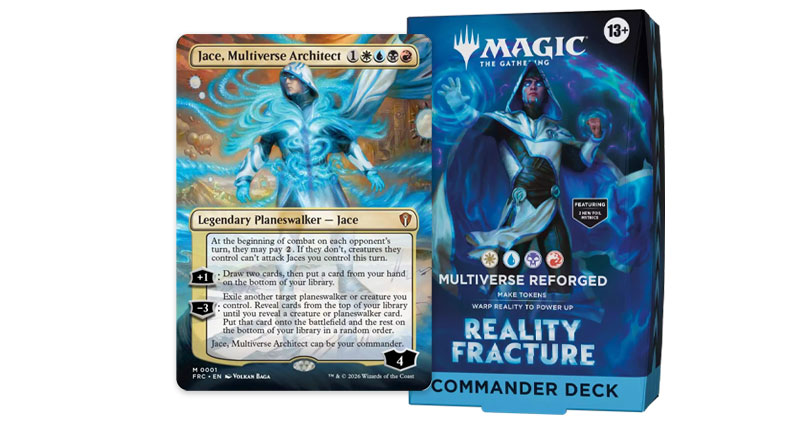
As expected, there’s only a single precon for the set, and Jace is the star of it. Multiverse Reforged is a four-color (Jace hates green, I guess) precon that acts as Magic’s first polymorph precon. Its face commander, Jace Multiverse Architect, is a five-mana planeswalker that starts with four loyalty points. He even has some personal protection, as he requires opponents to pay two mana to attack him or any other Jace cards you may have.
On the surface, the deck seems like it wants to be a token deck, but we’re feeding those suckers to Jace because that boy is hungry. Jace has two abilities: his +1 lets you draw, but his -3 is the big one here. That one lets you exile a creature you control, then reveal cards from the top of your library until you hit a creature; you can then play that creature for free, and the rest go to the bottom of your library. The cheapest creature in this deck costs six mana, so unless you can ramp quickly, your goal is to get Jace enough loyalty counters to pop his -3 ability and feed him token creatures so you can play massive ones like Darksteel Angel.
Cards like Lingering Souls or Skrelv’s Hive are going to be your big token generators, whereas stuff like Occult Epiphany, Memnarch the Warden, or Jace himself will be your draw engines so that you can get enough mana to start casting some of the bigger stuff if Jace is unable to. It’s a really neat deck when it works, and it’s filled with some insane legendary creatures.
Cards like The Ur-Sphinx or Archon of Cruelty are such game-changers when they hit the board, especially when you get to play them for free thanks to Jace’s planeswalker ability. It’s honestly a little exciting: you activate Jace’s ability and giddily start drawing to see which of your massive creatures you get to play for free.
As cool as this deck is, it still needs some serious tweaking to perform how it wants to. This is a situation where I think the Empower Jace ability should apply to all Jace cards (past and present). A lot of cards in this deck Empower Jace, but it feels kind of silly that, in the Jace precon, the main Jace card can’t benefit from it. Would allowing non-token Jace planeswalker cards to benefit from Empower Jace be a bit busted? Sure, but if any set you’d be justified in favoring, it would be one like Reality Fracture where Jace is a multiversal god. It’d also mean those older Jace cards could see new play. Alternatively, if that’s not an option, it’s a bit weird that this deck has no proliferate options.
The whole point of this deck is getting three loyalty counters on Jace so he can use his -3 ability to summon a big-hitter creature from your deck for free. That means you have to wait three turns to amass the counters and pray nobody targets him in the meantime (not likely). It also doesn’t help that the deck has little protection if someone targets Jace with a spell. There’s also the argument that Wizards’ true intentions with the deck is for you to take it apart to use one of its many legendary creatures as potential commanders of their own deck. Playing with this deck, I saw myself debating between gutting this deck to upgrade it so it plays how it feels like it should, or stripping it for parts to use for other decks.
Multiverse Reforged is a really cool deck, and Wizards of the Coast doing a polymorph deck for the first time is awesome. It’s just that your experience playing this deck depends heavily on the table letting you (slowly) take the time to make Jace do what he wants. If Jace isn’t summoning big monsters for free, it’s just not as fun.

Pick a Color, Any Color
Magic returns to Foundations, with a suite of commander decks. If you’re unfamiliar with the set, Foundations is Magic’s “starter” series; a set of cards meant to be friendly to players new to Magic. It usually includes incredibly popular cards from among Magic’s history, staples that anyone should want in their collection, and usually sticks to a few simple mechanics so as to not overcomplicate things.
I usually wholly recommend anyone new to Magic start with a precon from the current set, but these new commander decks might replace that. New to Foundations are five mono-colored commander decks that basically give you a good idea of how each color identity (mostly) plays. Now, while I only got to play with one of these decks, I still want to talk about the others in the set.
Giada Font of Hope leads the mono-white, angel-themed deck. Giada wants you casting angels, which, considering 30 of the 34 creatures in this deck are angels, you should have no problem doing. Cards in this deck either buff your angels or (to a lesser degree) give you life. With stellar staples like Lyra Dawnbringer and Patchwork Banner, Calling All Angels is a great commander deck for anyone interested in starting with white in Magic.
Keen Engineering is the set’s mono-blue deck and features Sai Master Thopterist as its commander. Typical with blue theming, unlike the other decks that focus on a creature type, this deck focuses on a card type: specifically artifacts. Whether it’s creating 1/1 Thopters with Sai, making cards cheaper to play with the number of artifacts you control with Thought Monitor, or putting +1/+1 counters on itself whenever an artifact is played with Kappa Cannoneer, artifacts are the name of the game here. It’s a slightly different way of thinking than the other decks, so it’s perfect that it’s the blue deck that does it.
Wretched Ranks is the black deck, and if there’s one thing you gotta know going into black, it’s that you’re either dealing with zombies or rats. Zombies are on the menu today, though, with Ghoulcaller Gisa as your face commander. She wants you to sacrifice your own zombies to create a horde of them. Why have one 6/6 Grave Titan when you could sack it to make six 2/2 dudes instead? The goal here is to overwhelm the table with a swarm of zombies, and cards like Endless Ranks of the Dead will help with that. It’s a really fun decklist, with some great zombie staples in it. If you love zombies, you should definitely try to pick this one up.
Now onto the deck I got to play around with: Reign of Dragons is the mono-red commander deck whose entire personality is playing dragons and winning cause it’s dragons. Led by Lathliss, Dragon Queen, you’ll be creating a 5/5 dragon token anytime you play another dragon, and you can pay some mana to buff them all too. If you’re not aware, dragon decks are incredibly powerful in Magic, and Wizards didn’t skimp with this deck. You’ve got some pretty powerful cards like Warstorm Surge, which states that anytime a creature you control enters, it deals damage equal to its power to any target. Since you’ll be playing a lot of dragons, this will trigger a lot and can effectively become a board wipe if timed correctly. Then you’ve got cards like Anger, which give all those dragons you’re bringing in haste. Topping it all off is Utvara Hellkite, which is just Lathliss but better (and more expensive). If you really want, you could even make Dragonmaster Outcast your commander. It’s a 1/1 for one mana, but you get a free 5/5 dragon every turn if you have six lands, which is very likely. Red is all about playing aggressively, filling the board with creatures, and attacking fast, so it makes sense that Wizards made the mono-red deck dragon-themed. It’s probably the most powerful of the bunch, and I can’t recommend it enough, as it’s a blast to play because, at the end of the day, dragons are just cool as hell, man.
Listen, man, this deck is called Tramplesaurus Rex, and it’s in green; you’re gonna play really big dinosaurs and not think too hard. At least, that’s what it should be. Out of the thirty-eight creatures in this deck, only eleven are dinosaurs. It’s more of a dinosaur/ef deck with a splash of random other dudes. It’s still a really solid deck, though, and it does what green does best: ramp up into massive creatures with trample that your opponents can’t do anything about. It has some green staples, like Unnatural Growth, which doubles all your creatures’ power and toughness each combat phase, or Ripjaw Raptor, which lets you draw whenever it’s dealt damage. It’s an absolutely solid deck, and the most green identity-playing deck you could think of; it’s just a bit of a bummer that it advertises itself as a dinosaur deck when it isn’t.
Final Word
Wizards of the Coast have been on an absolute tear with their in-universe sets this year, and Reality Fracture is a great way to cap things off. The core set is full of exciting new cards, the precon (while needing a bit of work) is a great concept piece to tinker with, and the new Foundations decks are fantastic places for newcomers to Magic to start playing Commander with.