















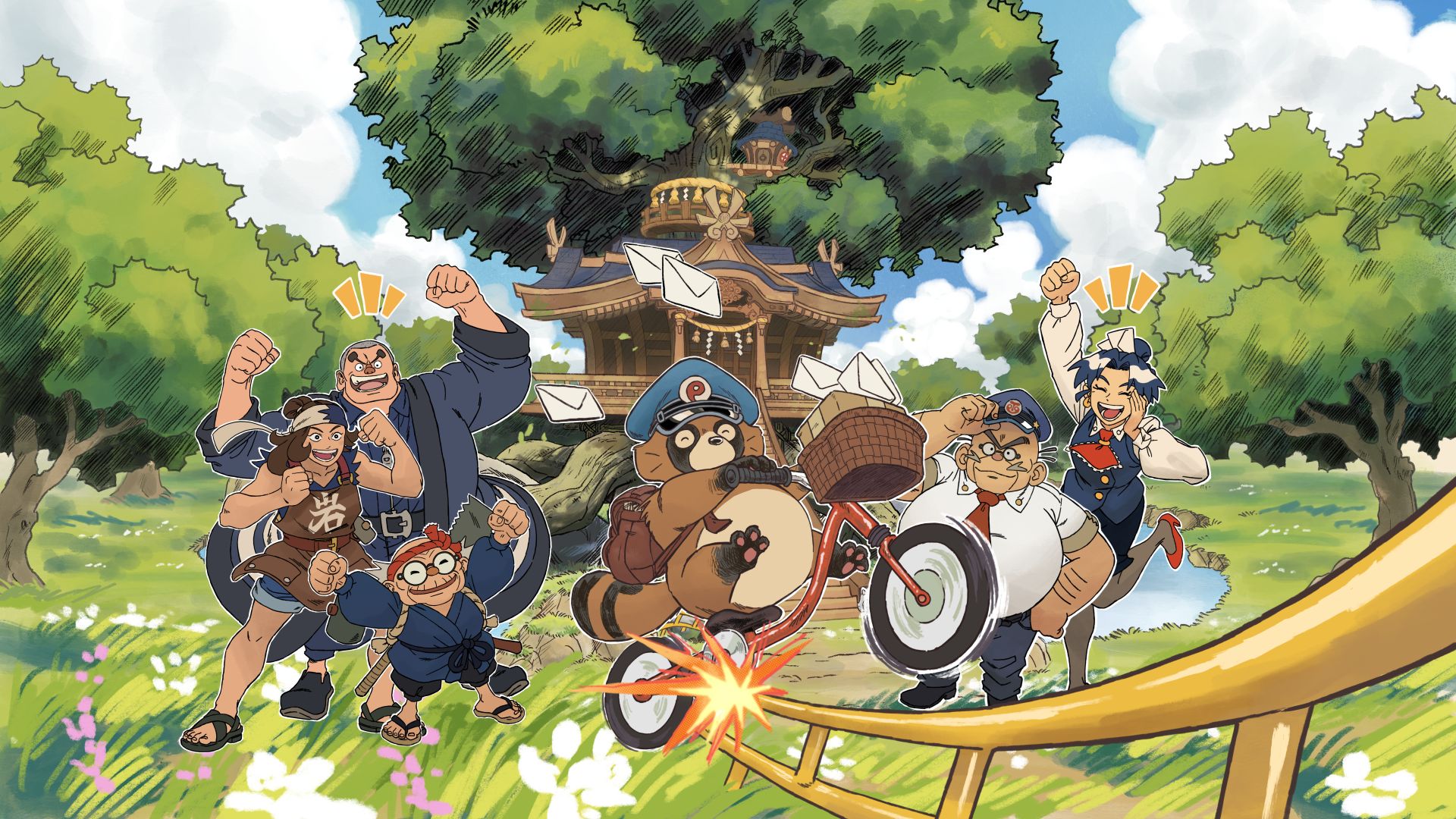

Fresh off our review of the game, we were lucky enough to get to chat with Liam Edwards, Game Director on Tanuki: Pon’s Summer. We touched on the game’s Tony Hawk influences and the real-life locations in Japan that inspired the game’s island.

Credit: Denkiworks
Was Pon always meant to be a tanuki, or did you guys experiment with other animals before settling on that one?
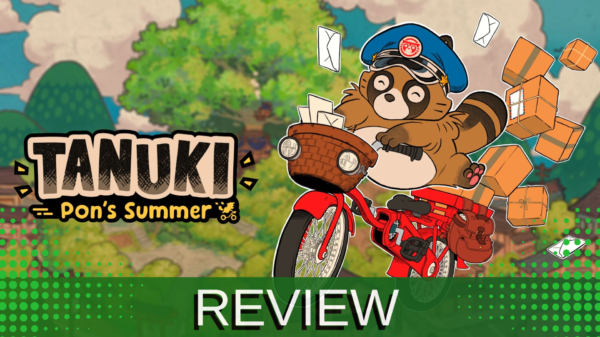
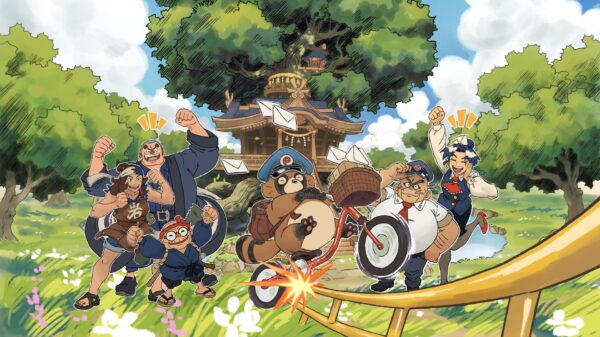
Liam Edwards: Right from the get go, we knew that we wanted an animal character instead of a human character. From there, we knew it would be based on the Japanese origins we were aiming for. While we never actually designed any other characters, we thought straight away there were too many games already featuring animals such as cats, dogs, and even foxes, and wanted something different. We previously had a prototype called “Tanuki Mech” and had planned for our characters to be tanukis. When we started this game, it just felt like a natural switch that the main character would be a tanuki. We already liked the animal, wanted something with a deep tie to Japanese culture and that has a great mythos we can draw from. Plus he also looked funny on the bike… haha.
What made you decide to build the game around working for the post office and delivering packages, and how did you keep it engaging for players?
Liam: The game’s original concept was just about cycling around a Japanese town or city. In keeping with that core, we started to ask questions as to why the player had to cycle around the town, what was the purpose to do so. Is it a game about exploring? Is it a game where you have a job? We needed something where we could get Pon to earn money, a reason as to why he needed to meet people, and what utilized the idea of cycling around. From there we thought he would be a courier of sorts, had to go to people or he was trained to deliver stuff, but it was a bit flat and felt sort of “un-Japanese” in structure. That’s when the idea of a post office came together.
It had nice parallels with the Shrine; a service that in modern times is not so used anymore, but is still a fixture of communities in Japan, especially in countryside towns. It being a post office allowed for us to then design a hub structure where there was the central place Pon could be given missions to go on and that could be anything we wanted, as it was easily understood by the player. Sometimes a player might think: “Why am I being forced to go talk to this character?” when they really just want to go off and do their thing. But for us that created a good excuse: Pon has a job! He needs to go deliver mail, and that’s why he ends up meeting all these characters. That loop felt simple and engaging enough that from there we could build on it and play with it in different ways.
What’s one small detail or feature in the game that you’re particularly proud of?
Liam: The game is full of references! Personal and cultural references, music, people we know… I think unless you worked with us or were a part of our friend group it would be hard to notice, but there’s so many. I wouldn’t want to give too many away, but there’s a lot of references to Japanese rock bands for example. And the in-game bar, Hashi, is modeled after a real bar in Kyoto we go to every week. To be able to be so personal with a game and get to make up all of these references has been a great joy and something I’ll be proud to be able to look back on in the future.

Credit: Denkiworks
Part of the game’s identity is its laid-back, summertime vibe. How did you approach capturing that feeling of a Japanese summer, especially for players who may have never experienced it themselves?
Liam: While it took a very long time and changed so much during the project until it landed on the final version, this was a concept that stayed from the beginning through to the very end. The game was always my own personal love letter back to the home I’ve now had for over a decade. The idea of bottling up a summer’s experience here in Japan – and sharing it with people – was always the goal. It sort of came naturally to us by making decisions based on the question: “Well, what would we do?”
In summer, we’d hang out by the river, we’d go to festivals, we’d meet friends, we’d try new hobbies – especially when you’re a kid. While the game is steeped in Japanese culture and experiences, that feeling of a “summer vacation” is quite common around the world, so we could blend them together quite nicely. I didn’t know if we’d actually achieved it but, from the response to the game, it’s been great to see that it really does a good job of sharing what a nice, quaint Japanese summer might be like for those who’ve never experienced it before.
Were there any challenges in balancing the energetic BMX gameplay with the relaxed, cozy gameplay of leisurely delivering packages and doing odd jobs around town?
Liam: So, so, so many! It was a really interesting game design challenge that seems to have landed, while still being rather controversial. The BMX was limited in the first versions of the game, but once we decided to just let the player do it anywhere and at any time, we really started to give it the attention and design thoughts it needed. We focused a lot on trying to make it feel almost like a Tony Hawk-lite experience, so that players of those games didn’t go away feeling disappointed. But in doing so, we didn’t quite realise we might be putting up walls for players who maybe weren’t so experienced in action games, and that could negatively affect the cozy experience they were wanting to have.
We cut some of our losses and met in the middle, making sure there were limited BMXing barriers so that players who wanted to just enjoy the setting and story could still enjoy it. At the same time, we filled it with optional challenges and experiences for the players who were digging the BMX.
This ultimately leads to a game that has a really interesting niche. I’m very proud that it’s a part of what makes the game stand out and be different. Ultimately our question always was: if you have to cycle from point A to point B, why would you not let the player jump around and do a backflip? That’s what I would want to do!
Now that the game is released, are players interacting with it in unexpected ways that have surprised you?
Liam: It’s still very early to tell, but I’m surprised to see just how many of the players are already trying to 100% it! I didn’t expect that. We’ve had a lot of messages from players wanting to know where insects will spawn or where to find certain challenges on the map, so that’s been a really nice surprise. We had lots of screenshots of people who have collected all the achievements and finished it.

Credit: Denkiworks
The island in the game is inspired by several Japanese towns: Kyoto, Aomori, Sapporo, and Beppu. How did you decide which characteristics of those cities were most important to incorporate into the game?
Liam: We took inspiration not just from our own city of Kyoto, but other places we’ve visited and enjoyed a lot in Japan. While a lot of the references ended up being objects – such as powerlines, manholes, buildings and decorations from each area – we also tried to capture the vibe of these places as they all feel so different from each other in unexpected ways. Beppu, for example, is our biggest inspiration for the second part of the island. It’s all built up on a hill and it features little hotspring pools with smoke rising from them. When you look at photos of Beppu you can just see a wall of houses and then smoke, it’s a really interesting town all built up on a hill into the mountain right next to the ocean. In lots of ways like that, we took things we really liked and just threw them all together in a big Japan soup.
If a player could walk away from the game with one particular feeling, what would you hope it’d be?
Liam: Just that they enjoyed their time with Pon. Does it inspire them to come to Japan, does it inspire them to maybe be a little kinder in their own community and maybe to share more positive media in the world? But above all, I think we just hope they look back fondly on their time spent in Pon’s world.
Tanuki: Pon’s Summer is now out on PC (Steam), Nintendo Switch, Switch 2, PlayStation 4, PS5, Xbox One, and Xbox Series X/S.