
















































It’s been a long wait, but Star Trek is finally here for better or worse. It’s a set that’s drawn a lot of raised eyebrows and finger-pointing about what’s wrong with Universes Beyond. Were any of those worries warranted? Well, yes and no depending on what’s important to you in Magic the Gathering.
Beam Me Up, Wizards
A loud amount of folks have been making quite a big stink about Star Trek the moment it was revealed as a Universes Beyond set, and despite being a pretty vocal proponent for UB, even I felt like the naysayers had some solid points. Here was a Universes Beyond set featuring an IP that I have zero affection for, with my most exposure to Star Trek being the Chris Pine movies, which I thought were okay. It didn’t help that a lot of the artwork for the set is done in that somewhat creepy, photorealistic style that I just don’t gel with in any medium.
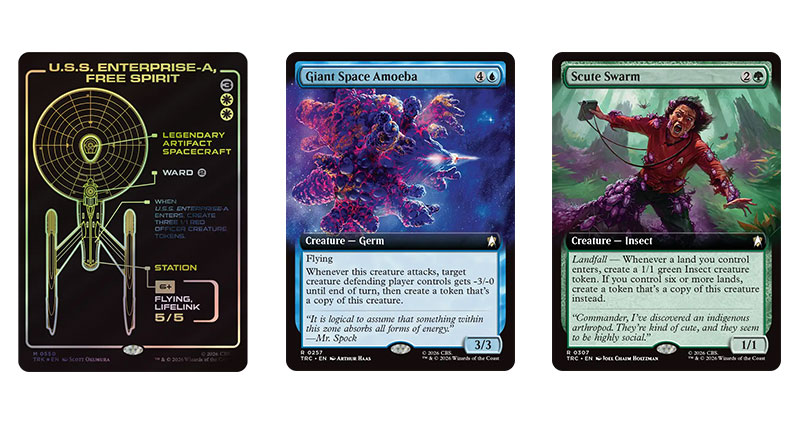
I do think part of what’s holding Universes Beyond back is the lack of a narrative. Here we have another Universes Beyond set that is just a smorgasbord of characters from a major IP, with a bunch of references to things in that IP, but no cohesive narrative tying it all together. There’s a card called “There’s Coffee in that Nebula” which lets you look at the top five cards of your deck and pull a land from it, I guess? And while I’ve not watched much of Star Trek, I know pacifism is a big part of things, so it’s weird playing a card like Data New Life, buffing it with +1/+1 counters and sending it into combat to “kill” an opponent. There’s a lot of iffy flavoring where the card text doesn’t match the character it’s assigned to. The Spider-Man set suffered from a similar problem.
Additionally, you have cards with some absolutely stunning artwork like Hull Breach or Interstellar Effigy, but then you look at ones like Pavel Chekov First Posting or Starfleet Spanner Jockey with their uncanny faces. I’m not going to claim every piece of art in every Magic set is perfect, but this is falling into that trap that a lot of comics fall into, where it feels like the artist is just tracing a picture of the real-life actor they’re supposed to be drawing, and it comes off super jarring in this photorealistic style.
Spacecrafts are back though! Easily one of my favorite new inclusions to Magic from Edge of Eternities, I immediately fell in love with the spacecraft card type, so I was happy to see Star Trek bring them back. There are some really cool new ones like Borg Cube, which lets you use the new Assimilate mechanic to exile a player’s creature (or your own) and bring it back to the field under your control, but now it’s a Borg with a +1/+1 counter (very good flavoring work here). Another of my favorites is Queen’s Diamond, which basically functions as a super mana rock where it lets you tap to gain one mana per charge counter on it. Its only hindrance is that the mana can only be used for your commander, but that’s still an incredibly useful ability to have, especially if your commander is being taken out multiple times. I think Wizards of the Coast really succeeded with their first foray into sci-fi with Edge of Eternities, and I’m hoping they can take some of what they learned from Star Trek into a future sci-fi set.
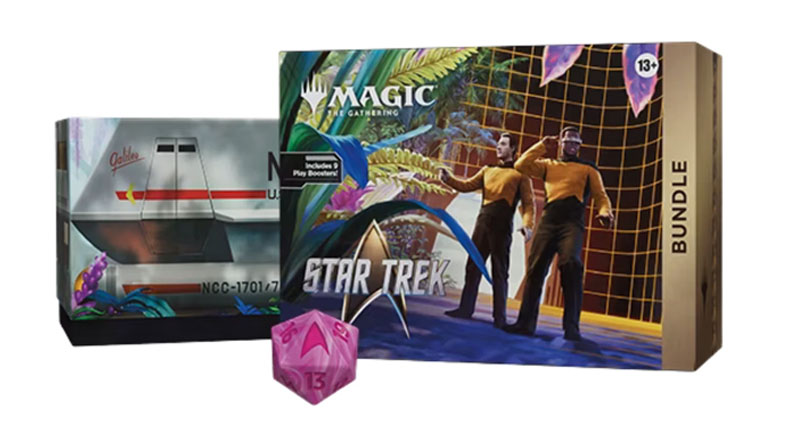
It wouldn’t be a new Magic set without new ways to play, and Star Trek comes with a few new mechanics to mess around with. Probably my favorite is Beam Me Up, which lets you play spells from your graveyard as long as you return a creature you control to your hand. It’s a really cool mechanic that lets you play things from your graveyard like flashback, while also benefiting from any creature abilities that trigger when creatures leave or enter the battlefield.
Say you’ve got a card like Energize, which lets you return a creature an opponent controls back to their hand. You play that, then let’s say you’ve already got Hologram Stalker on the field. After playing Energize, you then pay the Beam Me Up cost to play it again, and that will trigger Hologram Stalker to create a 3/3 token because Energize left the graveyard. Choose Hologram Stalker as the card you’re beaming up back to your hand, and then you can play it again, triggering its second ability a second time. There’s a lot of really neat potential you could do with this mechanic, and I’m eager to play around with building a deck around it.
Face a Dilemma is an interesting new mechanic that relies on a separate mechanic to trigger. Basically, anytime you play a card that lets you choose from a variety of effects, a card with Face a Dilemma will trigger. So, for example, Command Decision is a sorcery that lets you choose one of two effects to occur. After you pick one, a card like Melkotian Adjudicator would trigger and gain a +1/+1 counter. It’s a neat mechanic that works a little more passively than I usually play, but I’m sure someone will find a way to turn it into a busted deck.
Federation is a new ability that cares about non-Borg creature types you control. It feels like a more specific version of other Magic mechanics like Discover, since you’ll have cards like Hoshi Sato Exolinguist, which lets you look at the top X cards of your library, where X is the number of non-Borg creature types you control. Other cards like Infinite Diversity let you exile an instant or sorcery from your graveyard and copy it X times based on the number of non-Borgs on your field. Some of these are nifty, like Starfleet Academy, but I feel like there aren’t enough cards using this mechanic to really use it meaningfully.
Finally, Strange New Worlds cares about how many differently named lands you control, which seems ripe for commander play. This mechanic offers much more interesting variety than Federation, which works similarly, like Excalbian Gamemaster. That card lets you create X 1/1 red Officer creature tokens where X is the number of differently named lands you control. Or Chief Montgomery Scott (who’s absolutely going in a spacecraft deck), where you can tap him (for six) to put a creature or spacecraft onto the field, and it enters with X counters based on the differently named lands you have. (Diego)
While much has been said about this set, especially the art, I really have to commend Wizards for the depth of references they managed to get into this. Sure, most of it is just strangely photorealistic images of famous Star Trek characters. 500 Picards to go with the 500 Spocks, but they also did a good job of bringing some more obscure and weird things from the franchise. We have cards for cetacean ops, the dog in a lizard costume from TOS, and even that time Janeway got hyper-evolved into a salamander.
Flavoring is pretty hit or miss. It’s hard to theme a battling game around a famously pacifist franchise. The big Picard card gives +1/1s and tutors spaceships, which is fine, but it really isn’t what Picard is famous for. How do you even build around the galaxy’s greatest negotiator in a game where he has to fight demons & dragons? You can’t fault them too much, since you’d have to make more pacifist options in-game for this set, but I’d argue: if you’re making a Star Trek set, why wouldn’t that be the intention from the start? (Joe)
Slivers Walked So The Borg Could Run
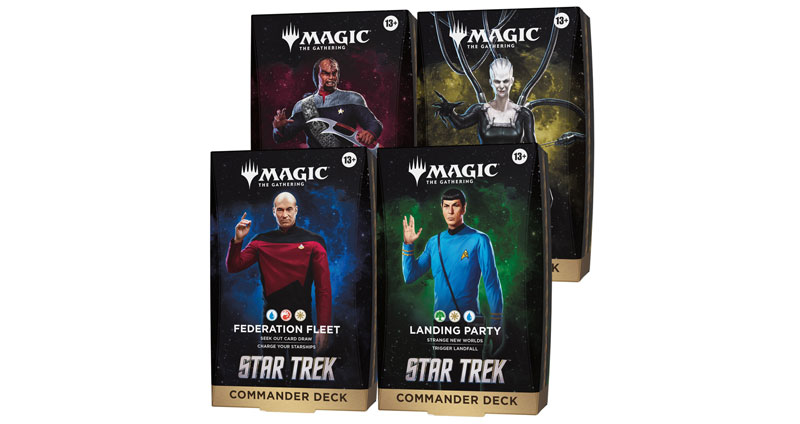
Star Trek releases four precon Commander decks for you to play with, and though I only got to play the Borg deck, I’m sure trekkies will find something that fits their style among the others.
The other precons available are Federation Fleet, led by Jean-Luc Picard Luminary as its commander; Landing Party, with Commander Spock leading the charge; and Klingon Fury, with Worf Defiant Commander in charge. Federation Fleet is all about drawing cards to gain card advantage and placing counters on your creatures or spacecraft. Landing Party lets you cast spells for free with Commander Spock and the new Strange New Worlds mechanic. Finally, Klingon Fury lets you exile cards from your deck with the new Battlefront mechanic and play them in the middle of combat.
Now on to the deck I got to play around with: We Are the Borg. This is a White-Blue-Black deck that features The Borg Queen as its main commander and Locutus of Borg as the backup. The entire deck functions like slivers, but selfish. If you’re unfamiliar, slivers are a famous creature type known for being difficult to play against because they can snowball so quickly. Slivers have abilities that give other slivers things like flying, indestructible, +1/+1 counters, hexproof, and much more. Once you get a few slivers on the field, you already have a pretty scary board, since they give each other multiple keyword mechanics. The one saving grace with slivers however, is that their abilities apply to the entire table; if anyone else is running slivers (or has a way to turn their creatures into slivers), then they’d benefit from your cards as well.
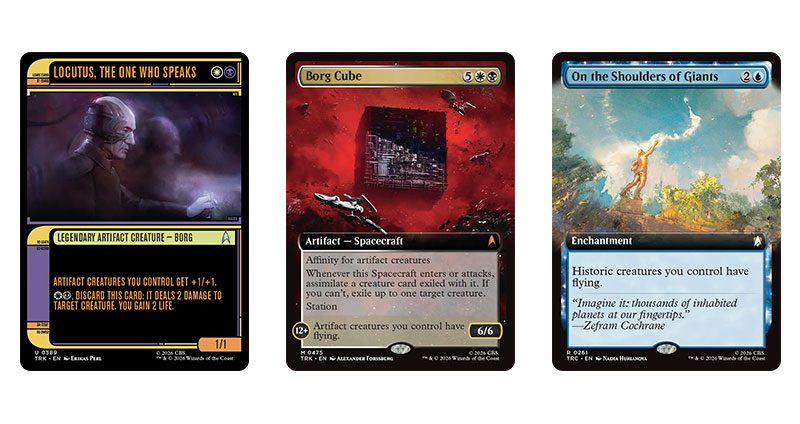
The Borg take this idea and ask, “What if we did what slivers are famous for, but make it so it only affects our own battlefield instead?” So where something like Winged Sliver states “All sliver creatures have flying”, allowing an opponent to potentially benefit off the card, a Borg like Supplementation Node states “Artifact creatures you control get a +1/+1 counter when they deal combat damage”. This means your Borgs get to function practically like slivers, with none of the downsides of having to share the abilities.
It’s honestly a kind of silly deck in that regard, because a big part of the deck is creating more Borg creatures so a game can snowball very quickly in your favor. At one point I had five Borg tokens (in addition to my regular Borg creatures) that were all 5/5 creatures with flying, double strike, vigilance, menace, lifelink, and ward 2, all thanks to One Borg Evolved. It’s safe to say I won that game after I swung at an opponent for 50 damage and gained myself 50 life. The deck is filled with really fun ways to abuse this, like Conquest Mission, which gives you a Borg token whenever you play an artifact (which the deck is exclusively filled with) and then lets you play two tokens once you’ve played six. It’s kind of ridiculous how quickly you can fill your board and also give all your Borgs multiple modifiers on top of all that.
Because of this, I feel like the deck works better with its backup commander. The Borg Queen wants you to use the new mechanic Assimilate (in addition to giving all your artifact creatures +2/+2). This mechanic makes it so that when Borg Queen attacks, an opponent has to exile the top of their library till they hit a creature; once they do, you get to take that card, add a +1/+1 counter to it, make it a Borg artifact creature, and the rest of the cards exiled go to the bottom of that opponent’s library. It’s a cool mechanic, but there’s not a lot in the deck that also assimilates, so you’re not going to be stealing cards very often. There are, however, a lot of cards that want to make more Borg, and that’s exactly what Locutus of Borg wants to do too. That card has lifelink and makes it so whenever any of your artifact creatures deal combat damage to a player, you’ll make a Borg token. This can snowball very quickly once you’ve got enough creatures out there. It’s also a much easier card to get out at four mana than Borg Queen’s seven.
Honestly, the only thing that really hard-counters this deck is if anyone plays a “destroy all artifacts” card, but even if it happens, you’re able to recover shockingly quickly. We Are the Borg is a total blast to play, even if it means you’re potentially the target at the table anytime you play it. If you pick it up, however, think about swapping the commander you use for it.
Final Word
Star Trek likely won’t be the straw that breaks the Universes Beyond’s back, despite it exhibiting some of UB’s worst aspects, as there’s still a lot to like here. Sure, some of the art and flavoring is jarringly off-course for Magic, but many of the cards have really fun mechanics, and the return of space crafts is very welcome. Star Trek might be a bit of a misstep, but I hope Wizards of the Coast can learn from it for future Universes Beyond sets, since I really do think Universes Beyond is a great way to bring new players into the game.