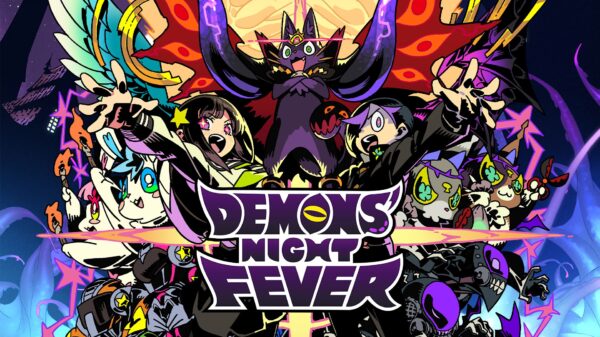









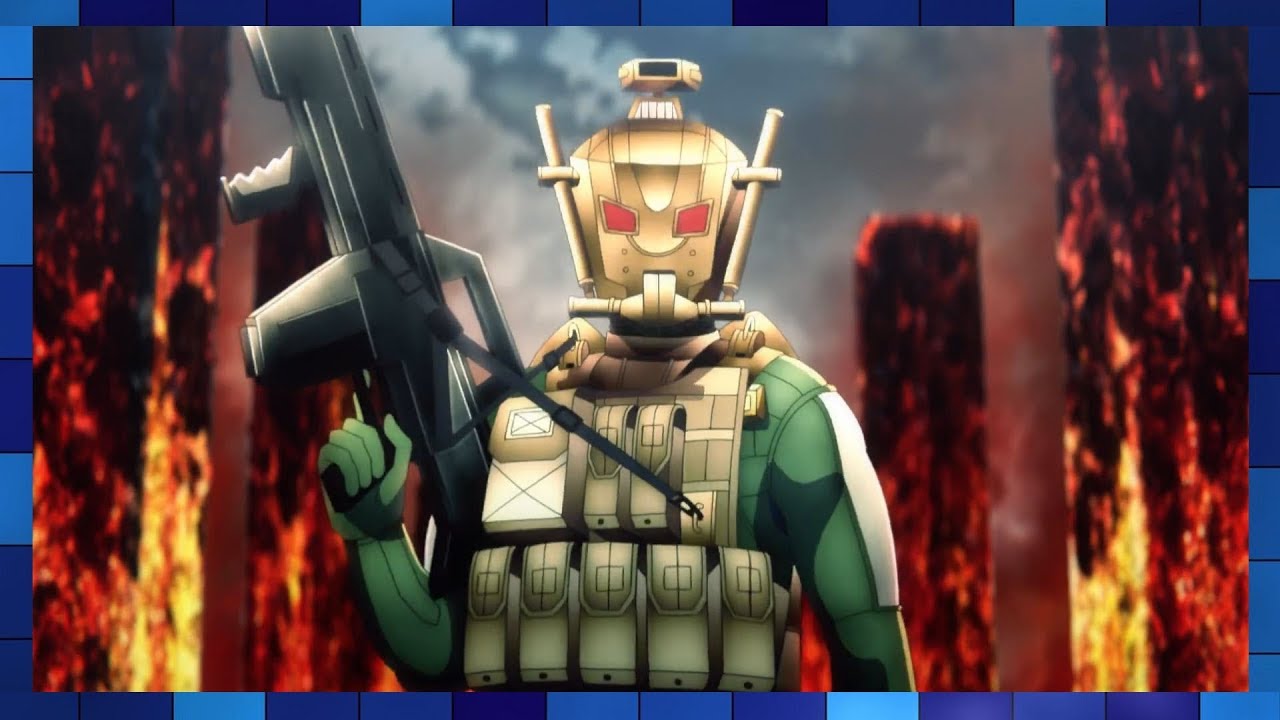


















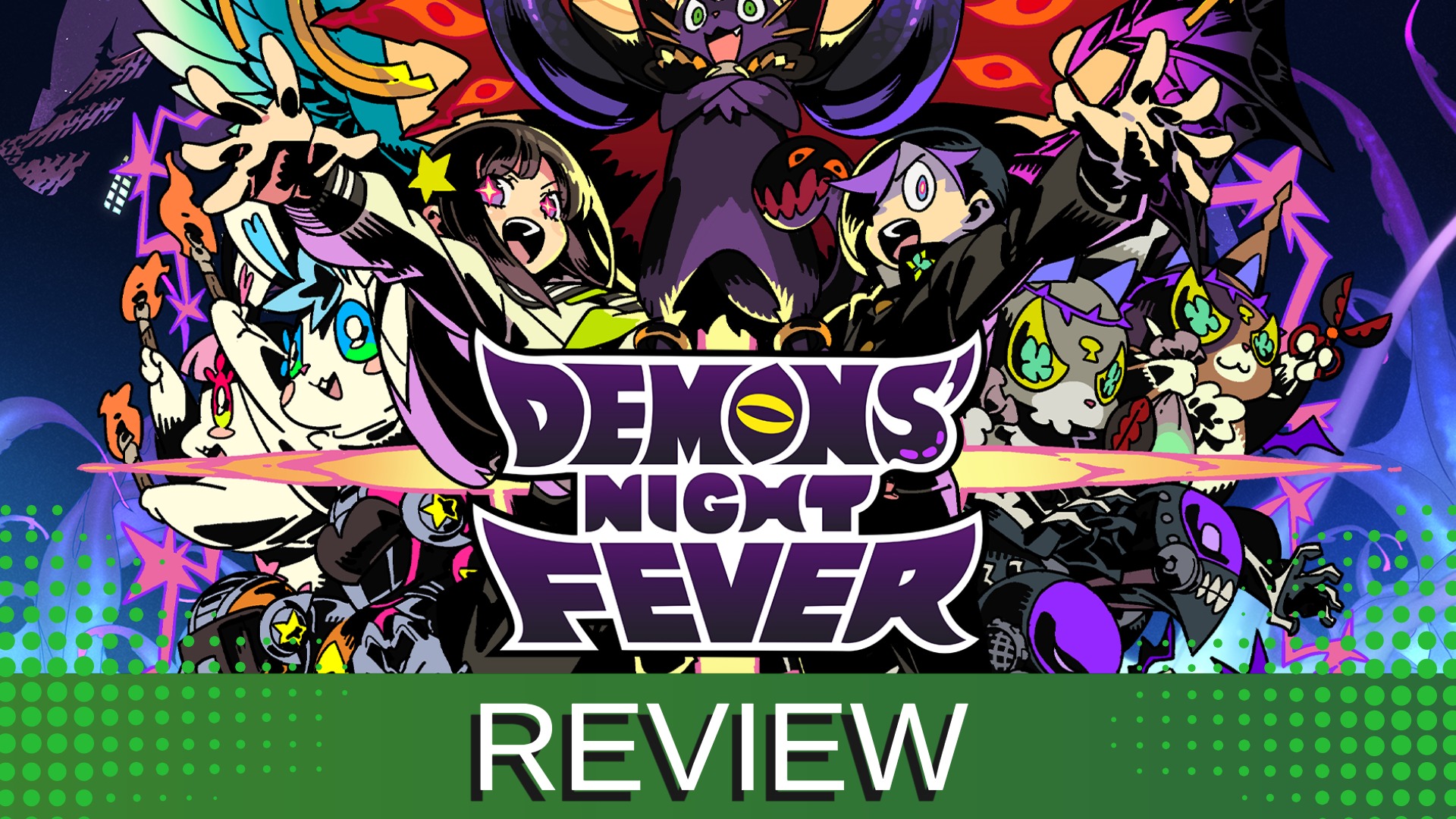

Demons’ Night Fever is a messy slog, with shallow tactics and meaningless progression. The narrative is at its best empty, but more often eye-rolling as it tries to make oil and water blend together. The visual novel cutscenes have a striking art style, but it’s nowhere near interesting enough to make this a party worth attending. The focus on killing your troops in combat never feels interesting or purposeful, relying more on randomness than any real strategy.
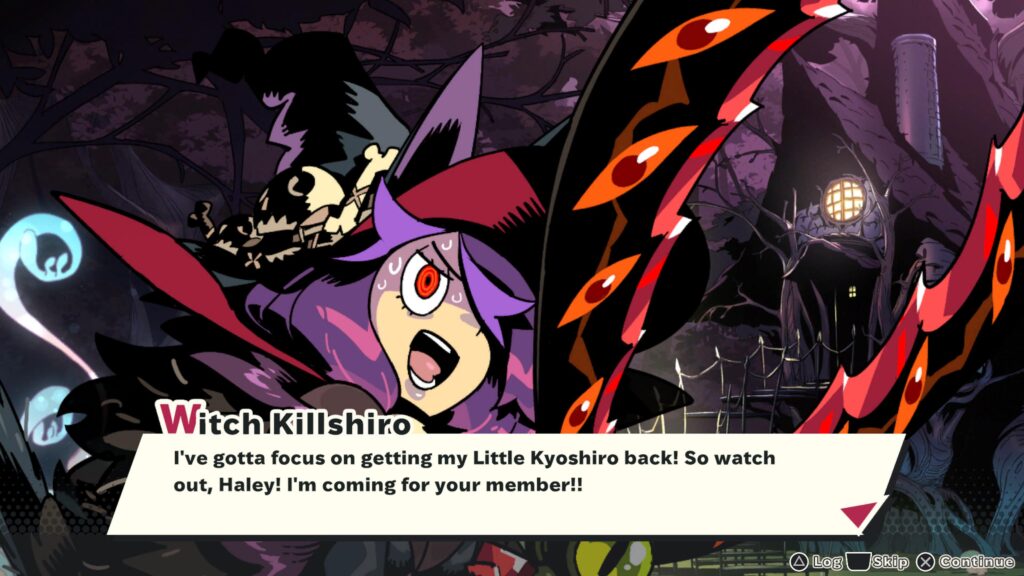
Killshiro, the chosen name of our loser Isekai protagonist, is killed at his dead-end job to help resurrect the devil Giga by completing a video game simulation of the Giga’s life. The narrative tries to play up the tropes here, with Killshiro being incredibly over the top pathetic and angry at the world due to having a rough time in middle school. Mocking this trope could work, but Demons’ Night Fever spends as much time just going through the motions of the tropes it wants to also mock.
This breaks with the Mary Haley character, Killshiro’s middle school crush who went on to have a successful modeling career, adding to his misery. It tries for the earnest “wow she’s a real person with real problems too” angle, but it lacks the depth to be engaging and only muddies any attempts at humor further. Most of the humor falls incredibly flat, with most of Chapter 2 focused on cutting off dicks, something that doesn’t land the first time and is driven straight into the depths of hell over and over again.
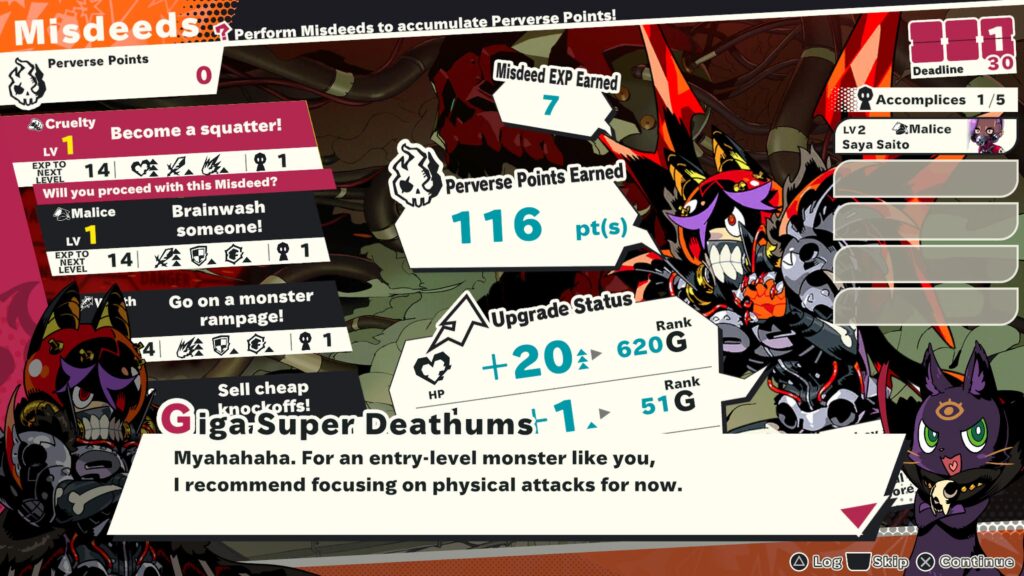
The structure of the game follows a strategy turn-based progression. You have a deadline of 30 turns to complete several event battles and a rank-up battle. To participate in these battles, you need enough Perverse points, which you can gain by doing Misdeeds. You just select these from a menu, where you earn different stats for Killshiro and points. You also have to abduct new Peons for your disposable army, and complete side tactics missions to gain experience. All of these systems go into increasing different stats, not to mention a skill tree that impacts the different Peon classes that also use Perverse points.
It’s far too much to keep track of, and it feels like a time crunch, despite that most of these don’t involve any actual gameplay. With Peons being disposable and killed in combat, there’s also little incentive to pay much attention to their classes and skills, especially when you can have several dozen in your army at once, depending on your upgrades. Many skill tree upgrades feel disconnected, too. It gives 4% stat boosts to a class like Malice Peons, but that number is hard to grasp, and skill upgrades are listed as a single level increase, which doesn’t give you much idea of what you’re actually getting. Since you can fail if you don’t complete a chapter in 40 turns, using Perverse points on upgrades is a big commitment and necessary, but too obtuse to feel meaningful.
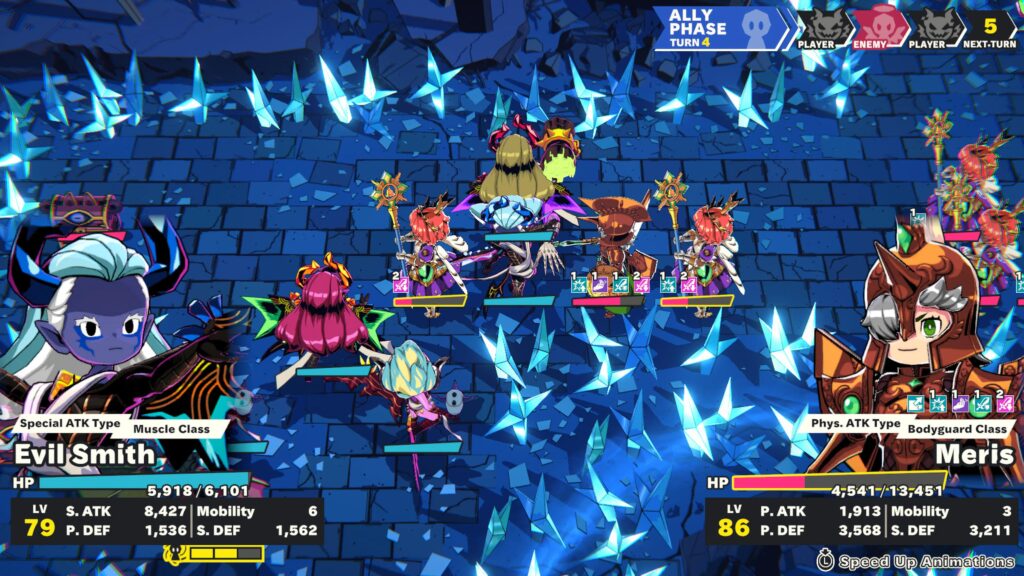
The combat sequences are the biggest letdown of Demons’ Night Fever. You drop into a map with a handful of Peons, who operate independently of you. You have a limited number of orders you can give, but those are also strategic and not direct. This is supposed to be where the tactics come in. You are supposed to deal most of your damage from Kill Skills, which can be activated by killing a Peon and are typically AoE attacks in a grid or cross pattern. Lining these up is tedious because, instead of ordering a Peon to move next to enemies, you have to move into that spot, teleport, swap places with your Peon, and then use the Kill Skill. I also often found that the Kill Skills would do zero damage because the stats are set up that way, so it’s often more tactically sound to let your Peons deal direct damage while you watch.
This system also lacks any satisfying tactical decision-making. The turn order is your Peons, you, the enemy, and you again, with Action Points largely carrying over between your two turns. You want to use Kill Skills to take enemies, but you don’t want to do it before your Peons move since fewer Peons on the map means fewer attacks. You can also summon new Peons onto the field, but the number is limited per battle by your skill upgrades. You run out of Peon placements constantly, and it feels limiting for a game designed around killing your units. It’s a dull way to approach a novel idea.
The maps are all incredibly basic. At most, you’ll get some buff generators you need to hack or objects in the environment to break, but that’s just more stuff you personally have to take care of as Killshiro. Since Killshiro is worthless for attacking enemies himself, it makes sense that he has to run around handling these, but you need to be within range of your Peons to activate Kill Skills, and you can’t direct them to a specific part of the map. Further, Killshiro dying is an automatic loss, so you have to be overly cautious, dragging the experience out.
Because units are disposable, the game also doesn’t put much love and care into their designs. Each chapter is a new evil era; monsters terrorizing a city, evil witches cutting off penises, and so on. The visuals shift between chapters, but each unit type still functions the same way, making every Peon feel identical. This also makes navigating the battlefield additionally time consuming. You don’t know what each unit can do because you have new ones every battle, so you have to drill into menus to see Kill Skill radiuses and other pertinent information. Most of the story battles in Demons’ Night Fever also include tutorials as small mechanics are added. These aren’t game changing most of the time, and since the narrative technically takes place in a game, the characters just straight up talk about it as a tutorial, adding the feeling of tedium.
Abysmal
The Final Word
It’s deeply unfortunate, but Demons’ Night Fever misses the mark in every way. The narrative is bland, unfunny, and pathetically earnest in developing a main character I’d rather see shot into the sun. The combat sacrifices tactical depth for randomness, and the dull map design leaves much to be desired. The in-between mission management lacks interaction and has far too many numbers and stats to be readable in any meaningful way. This is one party I wish I RSVP’d “no” to.