





























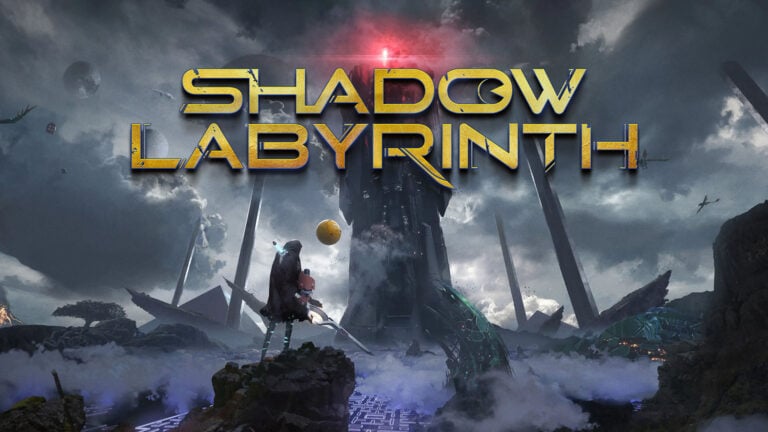

Explore, fight, die, repeat. This quickly became the cycle I found myself in while playing Bandai Namco‘s 2D Metroidvania Shadow Labyrinth. This game shouldn’t work on paper because it contradicts everything we’ve known about Pac-Man since its creation in the ’80s. However, in practice, it evolves into something rather unique, as the team takes the franchise in a bold new direction that is both challenging and engaging.
The story of Shadow Labyrinth is an interesting one, too. It takes place in a sci-fi world where the player has no memory of who or what they are. All they know is that they’re the eighth person known as Swordsman No. 8 that Pac-Man (Puck) uses to do his bidding, and you’re capable of wielding a sword that most can’t.

Shadow Labyrinth
Developer: Bandai Namco Studios
Price: $29.99
Platform: Xbox Series X|S (reviewed), Nintendo Switch, Nintendo Switch 2, PC, PlayStation 5
MonsterVine was supplied with an Xbox Series X code for review
One thing that I didn’t expect while playing this game was how often I got lost exploring. In hindsight, this shouldn’t have surprised me, considering the game is called Shadow Labyrinth. Despite there being a map, it only charts where you’ve been, and not where you need to go. As some might find this frustrating, the game quickly makes up for it by rewarding you for exploring the unknown. As you’d expect, there are plenty of places that you can only reach once you’ve unlocked key items, and this makes you feel as if you’re in a fun treasure hunt.

While exploring, I often found random bosses in hidden rooms that would reward me with an instant power-up. Or I’d stumble into a room holding some sort of collectible. Despite always being on the lookout for my next reward, I always found myself stopping to admire the scenery. What also made this enjoyable was how scenic many areas can be. It became a common occurrence for me, and this was only amplified by how differently the same area can look thanks to the day and night system put in place.
Once I found out where I was supposed to be, things started to click. But it wasn’t easy. Shadow Labyrinth asks its players a big question: ” Are you okay with dying with no checkpoint in sight?” This was something that took the wind from my sails. Nearly everything and everyone I encountered tried to kill me, so, needless to say, this made traveling extremely hard. Even more so when you consider that a single hit takes away a significant portion of your health bar. This, paired with the fact that I didn’t know where I was going half the time, would often make an unwelcome combo that I became accustomed to. But when those checkpoints/save points would appear, I felt as if I were the luckiest person on earth, because it then meant that I could be a little more reckless and try moves that I wouldn’t have dared just moments before.

However, with my high death count and hours of mindless exploring, I would eventually look to narrative plot points and bosses that I would have never thought of fighting. In true Metroidvania, many bosses are often larger-than-life monsters that throw everything they have at you. But thankfully, even though most fights are confined to tight spaces, Shadow Labyrinth gives you many tools to work around this. Sometimes that could be a climbable wall to help you escape danger, or a rail that can be used to help you get the upper hand. Most of the time, after I killed a main boss, I was often rewarded with an item that would help me reach areas that I wouldn’t have been able to explore before, or a new item that I could use to kill whoever was in front of me.
The game’s combat adds an extra layer of intensity that I enjoyed. In addition to managing your HP, I often looked at my energy bar. This would drain whenever I used any special attacks and evaded. At first, this may not sound like an issue, but things shake up when you throw a boss fight into the equation. Because my energy bar would almost always be drained, and this would leave me open to attacks. But it wasn’t all doom and gloom, thanks to the G.A.I.A. This was a feature that turned me into a Kiju Pac-Man. Whenever this was active, I was the strongest thing on the battlefield, and knowing to pop this ability often made all the difference when I found myself in a challenging situation.
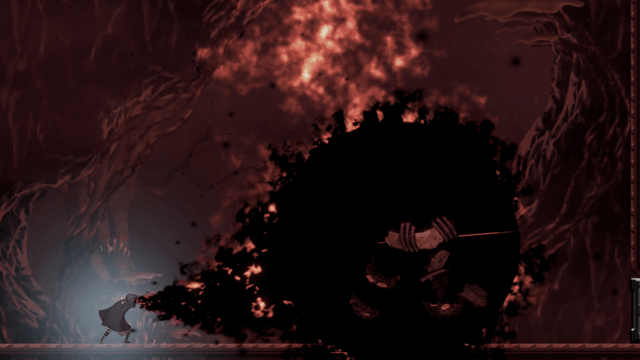
One thing that especially stood out to me was how much Shadow Labyrinth uses the UGSF (Universal Gaming Simulation Framework). In short, this is a narrative device that Bandai Namco uses to connect all of its games. As interesting as the story is, it doesn’t do the best job of explaining what’s going on. Instead, it relies on you to know what the UGSF is and to put all the missing pieces together. This can often be a double-edged sword because if you’re not a UGSF sicko or even know what it is, a lot of crucial moments will fly over your head. But on the flip side of this, it was nice seeing how Shadow Labyrinth fits into the larger picture, and seeing other Bandai Namco properties appear in big or small ways was always a joy to watch.
Shadow Labyrinth is, by all accounts, a Metroidvania game, but at its core, it’s still a Pac-Man game. There are plenty of moments throughout the game where the focus shifts back to the original game whenever I travel via rail, and it feels like a genuine treat when this happens.. Pac-Man makes the iconic noise we all know and love. As previously mentioned, Shadow Labyrinth is filled with mazes, but instead of looking at it from a top-down view, it’s now in 2D. Last but not least, you can still eat your enemies too, albeit in a more grim, dark way than what we’re used to.
 The Final Word
Shadow Labyrinth takes Pac-Man in a bold new direction in a way that feels natural in a weird way. It still maintains much of the original charm we’ve all adored. Even though the game is challenging and asks a lot of you, the rewards make it well worth it. The usage of the UGSF can often be hit or miss.
MonsterVine Rating: 3.5 out of 5 – Fair