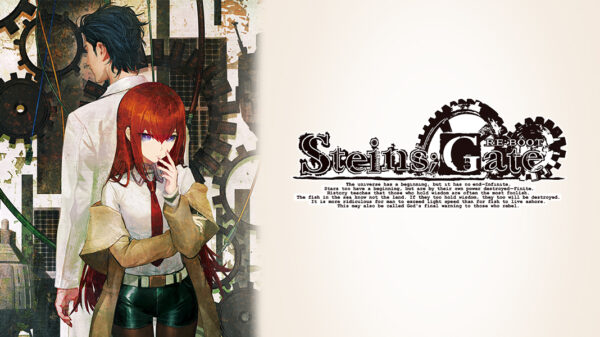























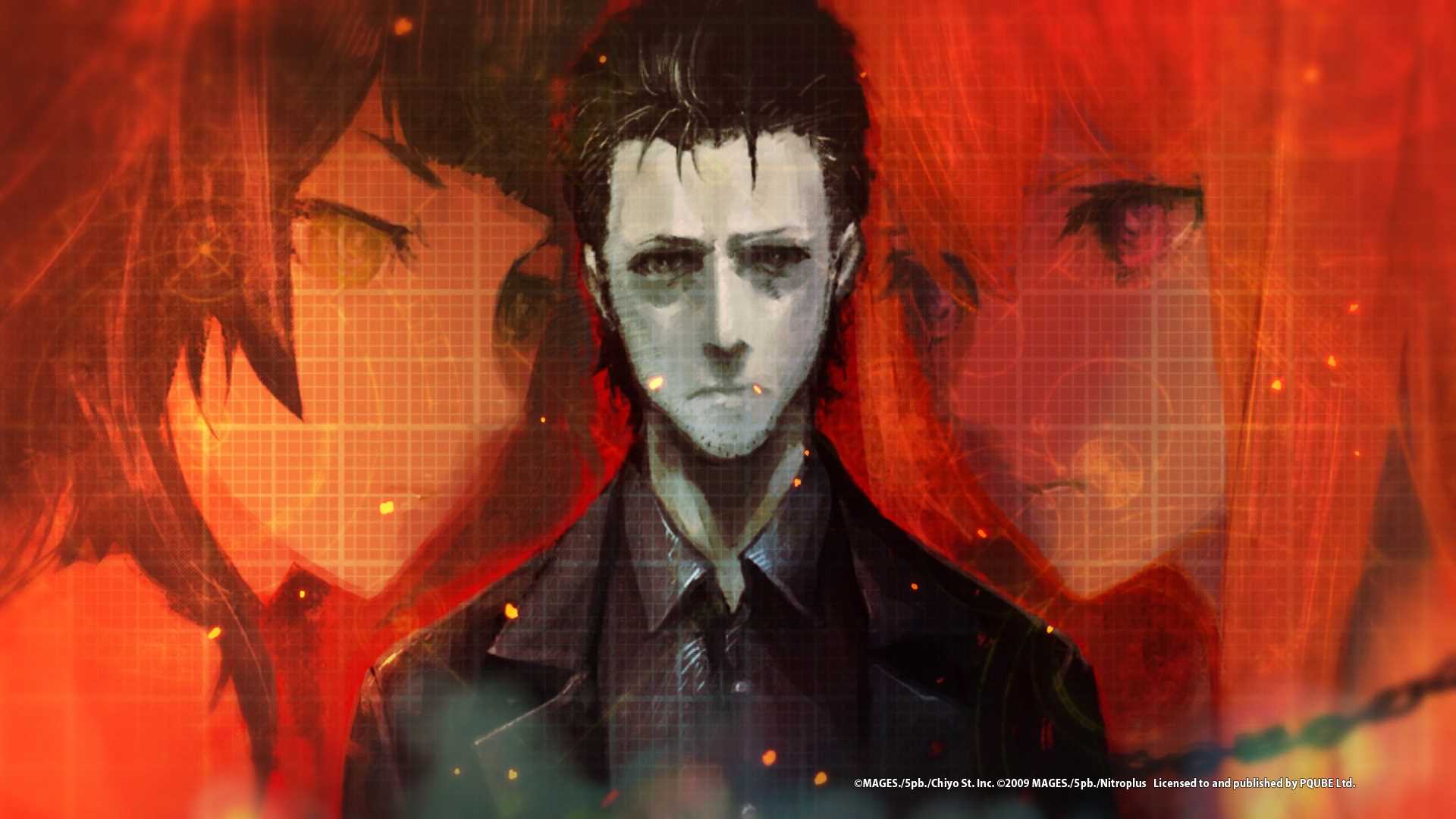

When discussing choices in Steins;Gate and its sequel Steins;Gate 0, the first thing to keep in mind is that choices are relatively few in number. These aren’t quite kinetic novels, but you definitely spend most of your time reading – and answering the occasional message sent to Okabe’s phone.
Steins;Gate is set up so that you can easily miss the choices on your first playthrough. It is largely linear, and you don’t have any input aside from answering message that seem inconsequential. The first major choice comes at a point when Okabe hesitates while deciding whether or not to send a D-Mail, a message that will travel back through time to change the current timeline. In that moment of hesitation, you can choose to open his phone and send the message yourself. If you don’t, he refuses to send it, and you’re put on the path to the earliest possible ending.
As a result, many players see that ending first. On subsequent playthroughs, the game alerts you with an icon whenever this situation arises. Most choices in Steins;Gate work this way: you either send a critical D-Mail and continue the main story, or you refuse to send it and see an alternate ending instead. It’s simple, and it gives you control of the timeline in a logical way. The only exceptions are the endings tied to the true ending flags, which depend on which responses you give to a specific chain of messages.
Steins;Gate 0 handles choices differently. Okabe doesn’t have D-Mail technology anymore, and he can’t directly control the timeline. Instead, the branching paths rely on how often you choose to interact with Amadeus, the AI on Okabe’s phone. Where Steins;Gate has a linear progression with alternate routes at key points, Steins;Gate 0 has multiple routes that branch out further down the path.

Unlike with the D-Mails, there isn’t always an obvious reason why interacting with Amadeus at particular times leads to certain routes. You can infer the reason for some, but other choices seem minor compared to the major changes they cause. On one hand, this emphasizes your lack of control in Steins;Gate 0. Powerful forces are making choices that change the world, and you’re swept up in their plots. On the other hand, it sometimes feels like there is no logic to the changes, and it’s simply how the designers chose to set you on different routes.
Both Steins;Gate visual novels present you with a handful of choices made through Okabe’s phone, but they do so in dramatically different ways. If Steins;Gate is a tight, mostly linear story that plays with time travel, Steins;Gate 0 is a sprawling collection of smaller stories and “what-if” scenarios that eventually lead back to the true ending of Steins;Gate. Choices feel less under your control, but allow for more varied routes.
I prefer how Steins;Gate handles it, although the sequel has its moments. Either way, when time travel and large-scale conspiracies are involved, small decisions can have huge consequences.