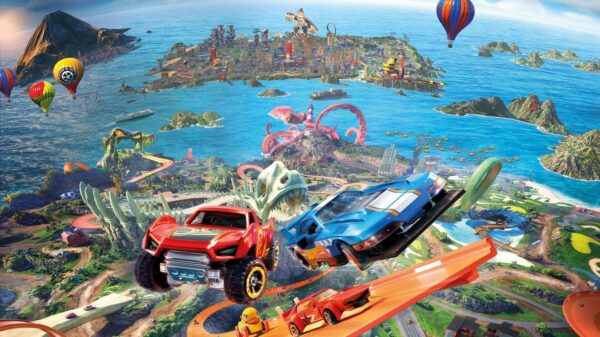



















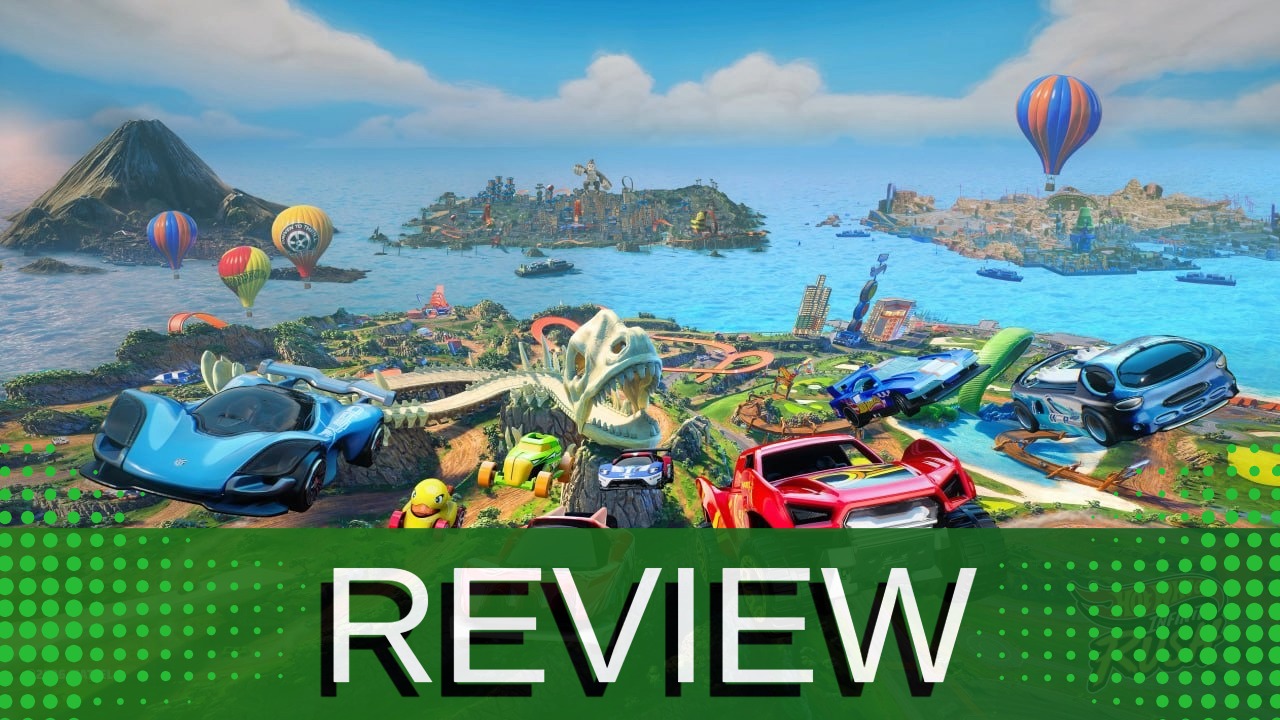

When I think of Hot Wheels, I think about taking one of their toy cars and doing sick tricks across the top of all the different furniture in my childhood living room. Hot Wheels is about good old nostalgic play, and Hot Wheels Infinite Rush delivers on that feeling by taking the solid arcade handling of its predecessor and combining it with an impressive open toy-box environment that captures the grand scale of your childhood imagination.
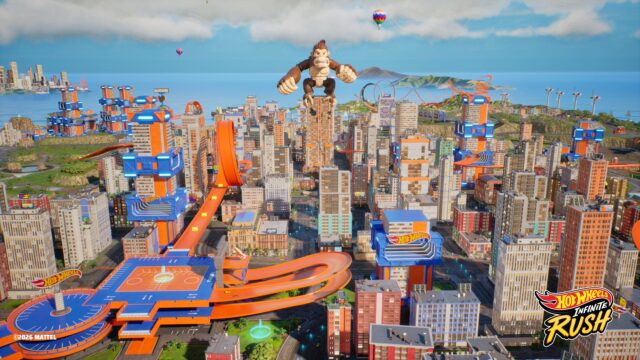
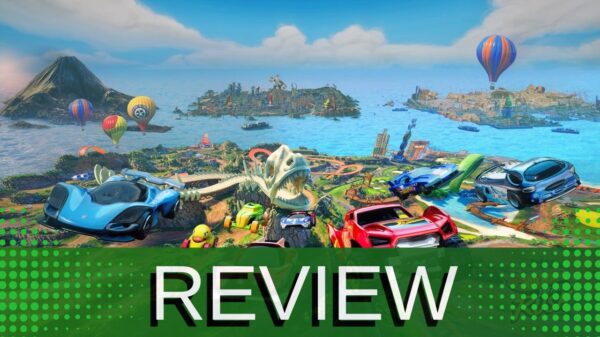
The open world of Hot Wheels Infinite Rush consists of four visually distinct islands, each its own dense little playset. While tracks in the Unleashed games were focused on photo-realism, Infinite Rush’s four islands look like charming toy playsets. The plastic buildings, oversized animatronics, highways that turn into loop-de-loops, and vibrant color palette nicely complement the many die-cast cars traversing the streets.
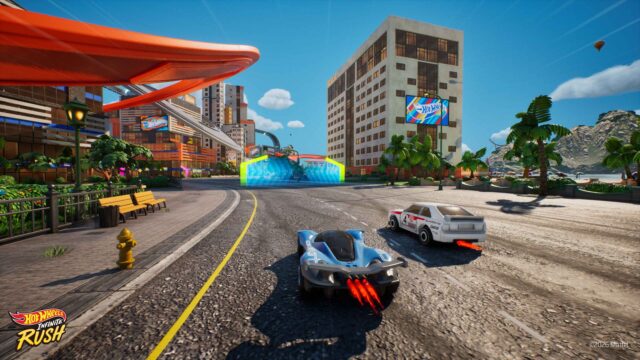
There is no fast travel, a smart and intentional design choice, since driving through the world is genuinely fun. Going from one edge of the map to the other never feels like a long road trip. Much of the world is interconnected through classic bright orange Hot Wheels tracks, loops, and ramps. Bushes, fences, and other street-level infrastructure are also destructible, and my inner kid never got tired of demolishing everything in my path. The driving is further enhanced on PS5 by resistance on the DualSense triggers, which provides a nice tactile touch. That touch, however, is missing in the terrain, where the visual variety isn’t backed up by gameplay variety. Driving over grass, asphalt, water, and dirt all feels the same, which is jarring at first compared to other racing games where the terrain noticeably alters the car’s resistance. Still, I wound up appreciating how the consistent handling keeps the arcade fantasy simple; no island ever felt worse to navigate than another because of it.
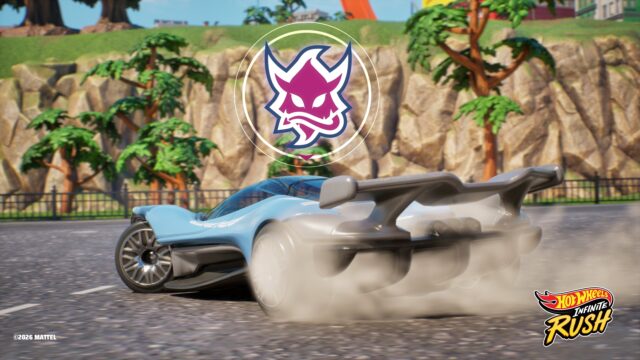
The open world consists of various side objectives to keep things fresh, such as time trials, deliveries, and even missions where you need to destroy as much of the environment as you can. The Tourist activity, which sends you hunting for specific photo spots, is a welcome change of pace. Slowing down to take in the art and environments let me notice little details of the world I would’ve missed while racing through it. While the world is a largely static and unchanging playset, it feels alive through the addition of Daredevil cars. These randomly spawned cars speed through the map, and defeating one in a short race adds them to your roster. Daredevils have some of the best stats in the game, and I found chasing them down was absolutely worth the detour. There are also collectibles to be found, such as decals that you can use to modify your car’s appearance through the extremely comprehensive editor. You can also adjust vehicles further by applying perks unlocked by completing various races. Perks increase some stats while reducing others or even grant immunity to environmental hazards. It’s a neat system that encourages you to explore the world and adapt the cars to your own playstyle.
Ultimately, I found the most fun was in the races themselves rather than the various open-world side activities, which started to feel like open-world bloat. This is made significantly worse by the inability to navigate the open world in local co-op. It would have been nice to collect and race through these charming toy sets with friends and family. The biggest detractor from the experience is that tracks available for quick races in local co-op are only unlocked after you’ve completed them in single-player. What I found really bizarre for an open-world racer is that launching and exiting campaign races is not seamless, with short but noticeable loading screens every time you do so. The same goes for moving from one Island to another, which makes the game feel slightly dated compared to what we expect from games on modern hardware.
After the poor reception to the story in Hot Wheels Unleashed 2: Turbocharged, Milestone decided to streamline the campaign for Infinite Rush by removing any semblance of a narrative. Instead, completing main and side objectives in marked campaign races on the map builds your reputation on each Island. Campaign progression is strictly linear at first and doubles as a tutorial, but after winning against the initial bosses of each island, you can freely pick and choose campaign missions in any order you like. These missions feature race modes fans will be familiar with, such as Time Attack, Quick Race, Elimination, and Drift Master, to name a few. The Waypoints mode, where you rush from waypoint to waypoint, is better than ever because now you can boost through the destructible environments and take any route you want. In fact, this mode highlighted one of the biggest negatives I have with the other modes: they feel too restrictive. You can carve out small shortcuts here and there, but every racer still funnels through the same checkpoints, which undercuts the whole point of an open world. Completing missions also earns you Rush Coins that you can spend in the shop to buy additional vehicles.
The diverse 150-vehicle launch roster splits into four distinct types that feel vastly different and completely change how you build boost. Versatiles provide balanced stats and gradually generate boost, while Speeders are harder to handle but gain boost by maintaining high speeds. Titans trade speed for rapid boost regeneration, but emptying the boost meter briefly slows them down. Drifters, as you might expect, build their meters by drifting and are great at Drifting Challenges. Certain vehicle types are better than others depending on the race mode and track. While the system encourages players to experiment with the best vehicle type for its side content, it forces you to use a predetermined type in the campaign races, which helps each race feel fresh and different.
The driving mechanics feel stellar and focus on arcade fun over realism, with tight controls, easy drifts, and the ability to dash left and right. I found the game’s medium difficulty to be quite easy, with heavy rubber banding that favors the player, allowing you to swiftly retake first place from last when making a mistake. On hard and very hard, this effect is lessened and should give veteran racers the challenge they are looking for. My biggest issue with races, though, was the inconsistent quality of the tracks on offer. While no track is bad, the most exciting ones mesh street-level races with classic bright orange Hot Wheels tracks, and that’s where the most fun usually is. That is because the truly fun track modifiers, such as magnetism or elemental hazards, are only found on traditional tracks, not in the streets. This became more apparent with every race I did, and I found myself wishing all races had the classic tracks, despite the beautiful world Milestone crafted.
This is where the community-made tracks will continue to deliver. I was pleasantly surprised by the number of modules available from real-life Hot Wheels sets. Between the various modifiers, track types, and environmental hazards, custom tracks end up being some of the most fun races in the game. In particular, the massive Shark Jaw module that snaps down onto cars passing through brought back fond memories of playing with that same set. A slight nitpick I have, though, is that because tracks have to stay continuous, you can never actually weave the surrounding open world island into your build. It serves more as a backdrop than something you can interact with, which feels like a missed opportunity. On the other hand, a welcome time-saving quality-of-life addition is the ability to have an AI car race your track to test it for completion before publication.
Fair
The Final Word
Hot Wheels Infinite Rush is a solid racing game when on the track, but the limitations on local co-op play and the frequency of immersion-breaking load screens hold back what could’ve been a great open-world racer.